


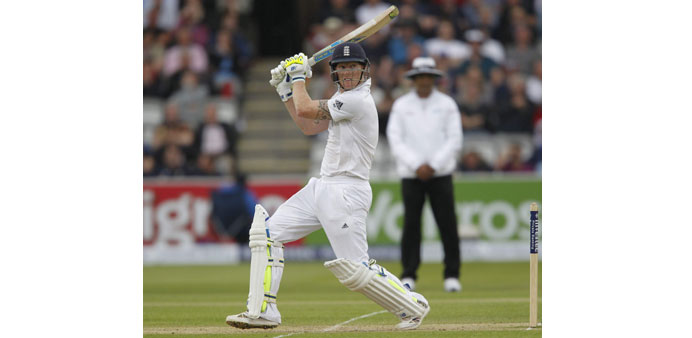
Ben Stokes form was so dire that he could not be picked for England’s World Cup squad. (AFP)
By Vic Marks/The Guardian
After Ben Stokes’s performance at Lord’s it is hard to avoid hyperbole. Actually it is hard to deliver hyperbole as well. So many superlatives have been flying in his direction that the lexicon is
running dry. In any case most of them seem justified and not at all hyperbolic in the warm afterglow of an unexpected Test victory. Alastair Cook, a grateful captain, plucked out “fantastic” and “unbelievable” after the game. How is this phenomenon to be accounted for?
Perhaps it is simpler to outline what Stokes cannot do. His running between the wickets is dodgy, though the way he bats does not give him much practice; 144 of his 193 runs at Lord’s came in boundaries.
He may be a little vulnerable against spin – the sort of reputation that cagey old pros have done their utmost to promote over the years. Five of his past six dismissals in Test cricket have been by slow bowlers, when he has more time to think.
Moreover, it is a fair guess that, when he is dismissed, he does not put his bat neatly and silently back into his cricket coffin before resuming the crossword.
As a bowler he cannot be depended on to keep his end tight. He does not always “get it in the right areas”. Sometimes he oversteps the mark – and not just when bowling. In the field, too, where his athleticism shines, he can be profligate.
There should always be an overthrow alert when the ball goes anywhere near Stokes. And the less said about the tattoos the better. Nonetheless there is a very good case for Stokes being retained in the Test side for Headingley and the Ashes and the two winter series after that.
But in sport hyperbole can give way to hypercriticism with astonishing speed. Everyone knows that the path will not always be smooth for Stokes. He will always be a volatile cricketer, which is another reason he will retain the capacity to mesmerise. Like his predecessors – with apology the names of Ian Botham and Andrew Flintoff have to be mentioned here – Stokes is brave enough to give himself leeway to succeed or to fail spectacularly. Others tend to pursue a less ambitious, more boring, happy medium.
The seesaw signs have been evident from the start. Initially he seesawed between continents, coming to England at the age of 12. His father, Jed, is a rugby league international for New Zealand who coached at Workington, and he recalls that the adjustment to England was not totally straightforward for his son.
“It was tough for him but he adapted pretty quickly, as kids do,” he said. “The biggest problem was the language barrier, believe it or not. They have got a very broad accent in Cumbria and he had absolutely no idea what they were talking about at first. Now he sounds even more Cumbrian than the Cumbrians at times.”
His parents drove him miles so that he could train with the Durham academy and before long barnstorming performances for the county sent him into the England Lions squad. But then Stokes was sent home from that tour of Australia after two breaches of discipline.
He was up again in Perth a year later when he struck a magnificent century against Australia in his second Test. Then he assaulted an innocent dressing-room locker in Barbados and broke his own wrist, which prompted a straight-talking father (there cannot be many soft rugby league internationals around) to call him “a wally”.
On his return to international cricket there would be only 43 runs in 12 innings for England in various formats. His form was so dire that he could not be picked for the World Cup in Australia and New Zealand. And now this: a sublime display decorating a memorable Test victory. Stokes may mature. But it would be wrong to anticipate too much caginess from him as he gets older.
In fact that is the last thing anyone should crave. He has to be given licence because that is when he frightens opponents. His father knows the score. “He is very much live by the sword, die by the sword,” he says. Stokes clearly does not like to be on the periphery of things.
If there is a scrap to be had, he wants to be in the middle of it. To his credit Paul Farbrace in his first – and penultimate – Test in charge recognised this. After the Lord’s match Farbrace explained how Stokes was promoted to No6 in the batting order.
“Ben is the sort of player who the more central he is in the game, the more you are going to get out of him. If he feels an integral part of the team, the more skill level we get. He’s batted six before and played very well and in the West Indies it was a very close call for the second Test when Moeen came back and Ben went from six to seven.
“That was tough on Ben but it was equally tough on Moeen in this game, especially since we wanted Jos (Buttler) to bat at seven. So there’s a bit of a scrap going on to keep their places in the order. Cooky and I chatted about this last week and we decided that was how we were going to go.
“Of course they all want to bat as high as they can. Ben’s taken his chance in this game and played brilliantly. The more we put him in positions of responsibility, the more overs we bowl him, the higher we bat him, the more we’ll get out of him.”
The opinion of Paul Collingwood, Durham’s captain, is similar, though more concise. “He’s a great character to have in the dressing room – a really strong guy and a match-winner. It’s as simple as that,” said the former England man – perhaps a tad ruefully, as it is hard to imagine Ben Stokes occupying a space in the Durham dressing room very often from now onwards.