


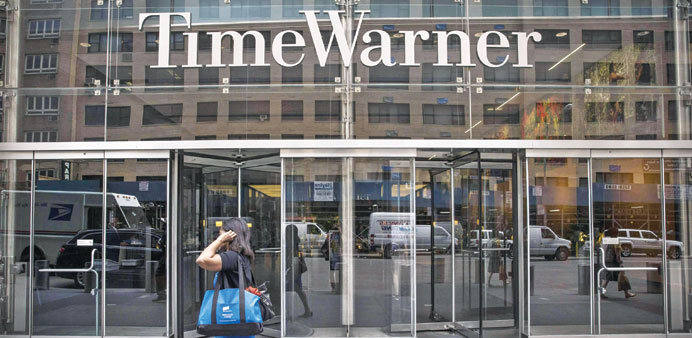
A view of the entrance to the Time Warner Centre in New York City. US cable company Charter Communications will pay $195.71 a share for Time Warner Cable, with options of $100 and $115 in cash and the remainder in its own stock, according to a statement yesterday.
Bloomberg/New York
Charter Communications Inc plans to buy Time Warner Cable Inc, clinching a deal made necessary by slowing growth in the US cable industry — and more expensive by last-minute competition from French billionaire Patrick Drahi.
Charter will pay $195.71 a share — 14% above Time Warner Cable’s May 22 close — with options of $100 and $115 in cash and the remainder in its own stock, according to a statement yesterday. Bright House Networks, a smaller cable company that Charter has previously agreed to buy, will also be merged into the combined entity.
It took Charter and its main shareholder John Malone more than a year to reach a deal with No 2 Time Warner Cable after their January 2014 bid of $132.50-a-share was rejected as a “low-ball offer” and Comcast Corp jumped in with a competing offer. Although Charter got another shot when regulatory scrutiny caused the Comcast deal to fall apart in April, talks were disrupted by Drahi’s Altice SA, which also approached Time Warner Cable in the past weeks.
“The idea that Time Warner Cable and Charter are merging isn’t a surprise, but the price raises some eyebrows,” Craig Moffett, an analyst at MoffettNathanson in New York, said May 24 after Bloomberg News reported a deal was near. “Altice undoubtedly contributed to Charter having to pay such a steep price to close the deal.”
Including debt, the transaction values Time Warner Cable at $78.7bn. The deal enables Charter, whose largest shareholder is billionaire John Malone, to almost quadruple its number of cable subscribers, gaining 12mn customers in cities including New York, Los Angeles and Dallas. The combined business will have about 17mn basic cable customers, second to Comcast’s 22mn.
To dispel concerns that cable mergers wouldn’t be approved by regulators after the Comcast-Time Warner Cable deal collapsed, Federal Communications Commission Chairman Tom Wheeler called Time Warner Cable chief executive officer Rob Marcus and Charter CEO Tom Rutledge recently, a person with knowledge of the calls has said. Wheeler told the CEOs that any transaction would be judged on merit, and there was no flat ban on cable combinations, the person said.
Wheeler repeated those comments yesterday in a statement, saying “the commission will look to see how American consumers would benefit if the deal were to be approved.”
Rutledge and Marcus said on a conference call that they were confident the deal would get approved.
Time Warner Cable shares rose to $184.83 before the US markets opened, while Charter gained 4.8% to $183.31.
Time Warner Cable shareholders who choose to receive $100 in cash will get 0.5409 Charter share. They can also elect to receive $115 in cash plus 0.4562 Charter share, the companies said.
The transaction is expected to be completed by the end of 2015, provided it gets regulatory approval. The deal values Time Warner Cable’s enterprise value at 9.5 times is earnings before taxes, interest, depreciation and amortization, based on 2015 estimates. That’s 23% higher than the average multiple of 7.7 for recent cable deals and 14% above Comcast’s proposed and abandoned bid, according to data compiled by Bloomberg.
Dealmaking has been heating up in an industry that faces waning demand for traditional pay-TV packages and competition from Netflix, Amazon and other online services. Although many analysts predicted a tie-up between Charter and Time Warner Cable, Drahi, a former protégé of Malone’s, made a surprise foray into the US on May 20 with the announcement of plans to buy a smaller provider, Suddenlink Communications. While in the country, he also met with Time Warner Cable CEO Marcus, according to a person with knowledge of the matter.
At $55bn, Charter’s offer will be difficult to top for Altice, a Luxembourg-based company that has a market value of about €32bn ($35bn) and ballooning debt. “It would be hard for Altice to structure a deal that would be as compelling for Time Warner Cables’ shareholders as a Charter deal,” said Moffett, the MoffettNathanson analyst.
Altice couldn’t immediately be reached for comment.
Liberty Broadband Corp, the Malone company that holds the stake in Charter as well as shares of Time Warner Cable, will buy $5bn of new Charter stock to help fund the deal.
The transaction has a breakup fee of $2bn, which anticipates a possible bid by Drahi’s Altice and antitrust concerns, according to people familiar with the matter.
Charter also renegotiated its offer to buy billionaire Si Newhouse Jr’s Bright House Networks for $10.4bn. That agreement had been in jeopardy because it depended on Comcast closing its merger with Time Warner Cable, which has the right to match or block the deal because of a longstanding arrangement to negotiate programming and other deals for Bright House.
Charter was advised by Goldman Sachs Group Inc, LionTree Advisors and Guggenheim Securities. Bank of America Corp and Credit Suisse Group also assisted Charter and provided financing along with Goldman Sachs and UBS. Morgan Stanley, Allen & Co, Citigroup Inc and Centerview Partners worked with Time Warner Cable.