


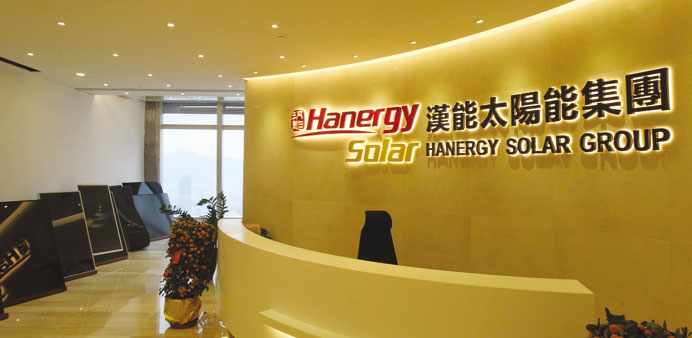
The blistering sell-off in Chinese solar company Hanergy Thin Film Power Group this week burnt several index-tracking stock funds, exposing the flaws in some of these investment structures, especially in volatile markets like China.
Reuters/Hong Kong/Singapore
The blistering sell-off in Chinese solar firm Hanergy Thin Film Power Group this week burnt several index-tracking stock funds, exposing the flaws in some of these investment structures especially in volatile markets like China.
One prominent fund late on Thursday announced changes to the index it tracked following Hanergy’s almost 50% tumble, suggesting other funds could follow suit and raising more worries for investors who were trapped when trading in the shares was halted on Wednesday.
Guggenheim Investments, which manages about $200bn, said the MAC Global Solar Energy Index tracked by its solar exchange-traded fund (ETF) was dropping Hanergy as a constituent, meaning the fund will have to sell its holdings of the Chinese firm when shares resume trading.
Critics of ETFs, which mostly track indexes passively, say while these products generally offer more liquidity than traditional funds, they are sometimes prone to illiquidity risks and redemption pressures especially when a big component in their underlying basket of shares faces a trading halt.
That’s especially applicable to the China markets, where ETFs have emerged as a popular investment tool. China-focused equity ETF and index assets under management have grown more than three-fourths to $132bn over the past five years to end-March, data from fund tracker Lipper showed.
Over the same period, assets of actively-managed China-focused stock funds have shrunk 12% to $199bn.
“While ETFs are great investment tools, competent active managers could be better equipped to deal with some situations.
Every ETF is different and investors must be aware of the underlying securities and treat them differently,” said Jackie Choy, ETF strategist for fund tracker Morningstar Asia.
On Wednesday, shares in Hanergy plunged 47% in less than an hour, wiping $18bn off its market worth before being suspended at the company’s request. Its shares had nearly trebled since the start of 2015 until Wednesday.
Some of the world’s biggest passive money managers, including BlackRock and Vanguard, were part of Hanergy’s journey that in two years lifted a little-known small-cap stock to a near $50bn solar giant before Wednesday’s slide.
BlackRock Institutional Trust Company, for instance, is Hanergy’s sixth-biggest shareholder, owning about $183mn worth of its shares.
One of the worst hits was taken by the $439mn Guggenheim Solar ETF, which had Hanergy as its single-biggest holding and had been buying into the stock recently, perhaps until end-April, according to Thomson Reuters data. The fund tumbled 7.8% in New York trading on Wednesday.
The troubles for passive managers are compounded when stocks are suspended from trading. In Hong Kong and China, stocks can sometimes are halted for months and years.
While a temporary suspension may not hurt ETFs which have the stock in their basket, a prolonged freeze may induce greater tracking error for the ETFs and create liquidity problems for the ETF provider, as they will have to find other proxies to substitute for the stock.
For investors, a fund’s high concentration of holdings in one stock may even force it to suspend redemptions, making it hard to exit the investment, some experts said.
While Guggenheim may have averted an immediate disaster by reducing the selling pressure from active investors in Hanergy using the ETF as a proxy to liquidate their holdings, the more the shares remain suspended the greater the tracking error for the ETF, reducing its attractiveness.
Marco Montanari, head of passive asset management, Asia Pacific at Deutsche Bank, said ETF providers could “take the extreme step” of suspending redemptions, locking investors out of their funds, if dramatic volatility in the ETF’s underlying basket of securities threatened its liquidity.