Reuters/London
Emerging market currencies and stocks fell yesterday, coming under pressure from a climbing dollar after better-than-expected US housing data.
The dollar index hit its highest level in two weeks after data showed April housing starts at the highest in almost 7-1/2 years, rekindling concern that the US Federal Reserve could hike interest rates sooner rather than later.
South Africa’s rand, the Turkish lira and the Israeli shekel weakened by as much as half a% against the dollar. The first two may also be affected by interest rate decisions in the next two days.
“There are a lot of cross currents for emerging markets, with the dollar (moves) and oil prices so volatile,” said Ilan Solot, strategist at Brown Brothers Harriman. “The dollar trend is the biggest uncertainty there is.”
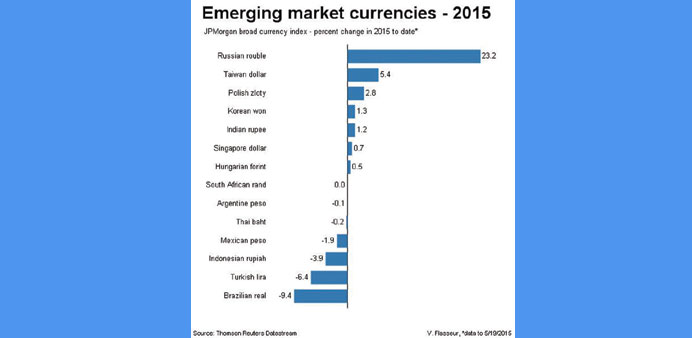
Russia’s rouble slipped more than 1%, seesawing around the key 50 per dollar level, despite oil prices rising 1%. The finance ministry and the central bank are both purchasing dollars to stem the currency’s appreciation.
“There have been a lot of factors supporting the rouble. One is the oil price and the second is the pricing out of (Ukraine-related) political risk, but now I can’t see a catalyst for another leg higher,” Solot said.
But Russian sovereign dollar bond spreads - the premium investors demand to hold its debt over US Treasuries - fell below 300 basis points for the first time since the end of July 2014.
The euro slid to a two-week low after a Greek official said Athens may not make an upcoming payment to the International Monetary Fund.
The somber mood helped drag down eastern European currencies, with the Hungarian forint and the Polish zloty both around 0.3% weaker against the euro.
Emerging shares fared little better, with the MSCI emerging market index falling for the third straight session, down 0.4%, while the MSCI Asia ex-Japan index slipped by 0.3%.
Stock markets in Poland, Romania and Greece all fell by some 0.7%, while dollar-denominated stocks listed in Moscow dropped by 2.7%, the last heading for their steepest fall in over a month.
Meanwhile, Chinese bourses ended as much as 0.7% higher, lifted by a rise in tech-heavy, Shenzhen-listed shares after the city’s stock exchange raised the number of firms included in a benchmark index.
South Africa’s central bank is forecast to leave repo rates unchanged at 5.75% when it meets today.