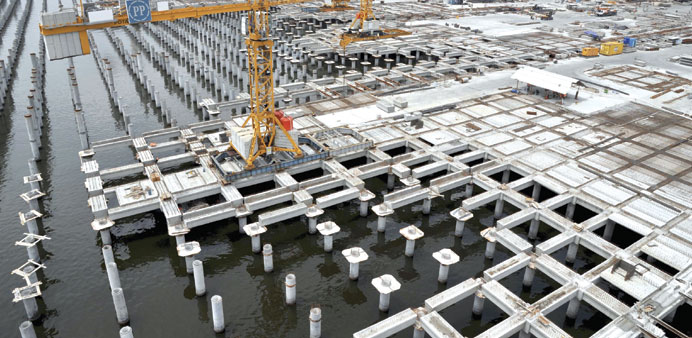
A general view of the construction at the Kalibaru Container Port, North Jakarta. Investors encouraged by President Widodo’s five-year $455bn plan to beef up dilapidated facilities have pumped money into the country’s big four state builders.
Reuters/Jakarta
For Indonesia’s second-largest state construction firm PT Wijaya Karya Tbk, the half-year since President Joko “Jokowi” Widodo took office with promises of a massive infrastructure push has been as much about waiting as it has been about building.
Like its peers, Wijaya Karya had expected a revenue boost from the 290tn rupiah ($22bn) the government had budgeted for infrastructure projects this year, a more than 50% increase from the previous year.
Investors, equally encouraged by Widodo’s five-year, $455bn plan to beef up dilapidated facilities, have pumped money into the big four state builders. Shares of Wijaya Karya, PT Waskita Karya Tbk, PT Adhi Karya Tbk and PT Pembangunan Perumahan Tbk now trade at an average of 22.4 times their expected earnings for the next 12 months, above the average 15 times ratio for listed Indonesian firms.
These valuations, however, look increasingly precarious as the hopes that accompanied Widodo into office last year collide with the red tape and land disputes endemic to Southeast Asia’s largest economy.
“We had made the lowest bid for many projects, but the government hasn’t announced them yet,” Wijaya Karya CEO Bintang Perbowo told Reuters. “As there’s a delay on the government side, we have to tweak our strategy.”
Foreign investors have accounted for 42% of the Indonesian stock exchange turnover so far this year, and Thomson Reuters data shows Baring Asset Management and FIL Investment Management were, as of March, among the top 10 investors in Wijaya Karya.
The company, like other state contractors, is expected to support the government’s infrastructure push and had banked on state projects to account for more than half of 31tn rupiah it targeted for contracts this year. But worried about the government delays, it is now aggressively chasing private sector clients, Perbowo said.
“There isn’t much time left,” he added.
Total revenue of the four state contractors fell 9% in the first quarter, the biggest drop in two years, Thomson Reuters data shows. This reflected the lack of government disbursement, brokerage Danareksa Sekuritas says. As of April, the government had spent less than 2% of its 2015 infrastructure budget, the finance minister told a national planning meeting.
Several ministers have blamed the slow allocation of funds on the government’s revision of the state budget in February to partly reflect the abolishment of fuel subsidies, but bureaucratic tangles also abound. A $43mn reservoir being built by Waskita Karya, for example, has run into delays because of bureaucratic difficulties in clearing the land, Corporate Secretary Anton Nugroho told Reuters.
Analysts and some officials say the real hurdle facing infrastructure projects is the same blighting nearly all sectors of the economy: the disconnect between what Widodo says the government can do, and the reality.
“You have Jokowi still saying the right things, but at the end of the day he has to be supported by the rank and file,” said Wellian Wiranto, economist at Singapore’s OCBC Bank. “Not just the cabinet, but also the bureaucracy at large, and that part I think is still not getting the message.”