


DPA/Pagasa Island
Ronnie Cojamco used to roam the turquoise seas around Pagasa Island in the western Philippines when he went fishing.
But now, he doesn’t stray far from the shores of the largest territory occupied by the Philippines in the disputed South China Sea, as Beijing presses its claim to the area.
The 40-year-old father of three says he will usually turn around whenever he sees a Chinese boat, out of fear of getting captured.
“We don’t know how these people think, so it’s better to avoid them. They are always around us. We can see they are building something on Subi Reef,” he says, pointing to a growing land mass about 25 kilometres from Pagasa.
“That used to be just a reef, but it’s now like an island,” he says.The Chinese reclamation work can be seen from Pagasa, a 37-hectare island that is home to fewer than 100 Filipino civilians and an undisclosed number of soldiers.
Cranes on huge ships loom over Subi Reef during the day, and at night floodlights illuminate the area where dredging machines suck sand from the sea to dump on the reef.
Pagasa residents are acutely aware of the escalating tension with China, but insist they are staying put to boost the Philippines’ claim.
Pagasa, which means hope in the Filipino language, is part of the municipality of Kalayaan, or freedom, in the western province of Palawan.
It was initially only inhabited by soldiers, but authorities encouraged civilians to relocate there with offers of permanent jobs building government infrastructure. A civilian community was established in 2002.
China claims nearly the entire South China Sea, and has been building structures on several reefs and islands. The Philippines has filed an arbitration case challenging Beijing’s claims before the UN.
Cojamco, a resident for the past 16 years and the operator of the island’s electric generator, admits that he fears a Chinese invasion.“Of course I’m scared, especially since my family is with me here,” he said as the Philippine military’s chief visited the island for the first time in decades last week. “But we are prepared to die here if that is our fate because we know that this is our territory.”
The military has been training Pagasa’s residents on emergency situations, including teaching them how to use guns, as part of the contingency plan for conflict on the island.
“That’s part of their responsibilities,” says Major Ferdinand Atos, commander of the troops on Pagasa. “Whatever happens, they will have participation in any preparations being undertaken to defend our country, our independence, our island.”
Atos refuses to reveal how many soldiers are stationed on
Pagasa, where two 40-millimetre anti-aircraft guns stand on either side of the island’s runway. But he stresses that fortifications and preparations are being made in case of an attack.
Rovelyn Jugo, a 22-year-old mother of a young son, said she tries not to think about the threat on the horizon because the island has been good to her family since they moved here last year. “Life is simple here and quiet,” she says, while selling souvenir T-shirts, mugs and canvass bags to visitors joining the military chief’s trip. “Everything is free so we are able to save.”
The municipality provides monthly rations of rice, canned goods and other basic supplies to the residents, while housing, utilities and school are free.
But Jugo, whose brother-in-law was the one who encouraged them to move to Pag-asa, said they are prepared to leave if necessary.
“We are ready to evacuate if we have to,” she says. “Our things are in plastic containers that we can easily take with us.”
Kalayaan Mayor Eugene Bito-onon says the island still lacks key elements to make life sustainable, including a port that would allow ships to dock, a commercial runway and a bigger power source.
“We can’t have too many people on the island because the environment and infrastructure cannot handle it,” he says. “We don’t even have a doctor, and the forest will be destroyed by people getting wood for cooking.”
Electricity, which comes for a 75-kilowatt generator and solar panels, is only available for up to six hours a day in the evenings.
There is satellite television, allowing residents to keep up with their favourite soap operas and the latest fight of boxing icon Manny Pacquiao, but communication signals are spotty and can be down for months due to technical problems.
Residents hang their mobile phones on rusty rails of the airport tower, where signals are strongest.
For some settlers, like Cojamco, the difficulties they encounter are outweighed by the significance of their presence.
“It’s important to have a community of Filipino civilians here because our residency establishes the fact that Pagasa is a territory of the Philippines,” he said.
“It will be painful if we lose Pagasa, because this is ours.”
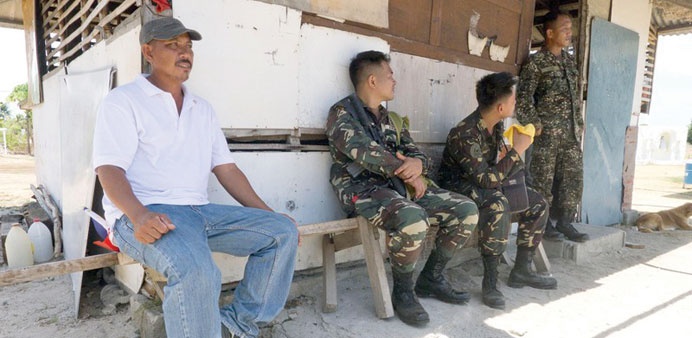
Ronnie Cojamco, 40, sits on a bench with soldiers assigned on Pagasa Island, the largest territory occupied by the Philippines in the disputed South C