


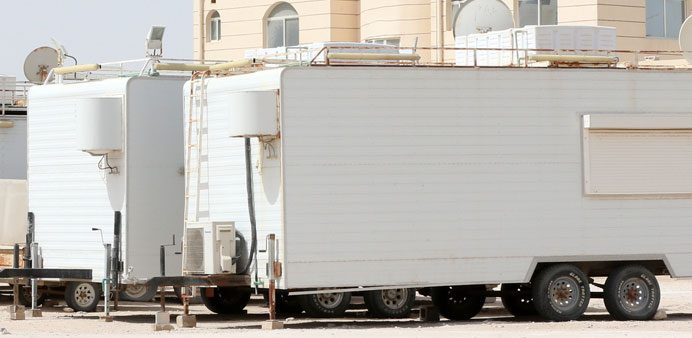
High-quality portacabins conforming to various standards are a safer and more durable
option. PICTURE: Jayan Orma
By Ramesh Mathew/Staff Reporter
With the possibility of fires increasing during the summer, questions are being raised over the quality of portacabins used to house workers in the country.
Many of the portacabins are made of cheaper material that pose a safety threat and are vulnerable to fires in adverse weather conditions, say sources.
Besides workers living in such portacabins, some reputable manufacturers, too, have expressed concern over the large-scale presence of portacabins of dubious quality in the market. They say these could be responsible for accidents such as fires to a large extent.
A senior representative of a major portacabin maker said prefabricated, fire-rated portacabins not only offer 10-15 years of durability, but also provide better safety to their occupants. However, they are a bit expensive, which prompts many contractors to try and bypass the country’s strict safety guidelines and go for cheaper solutions while considering housing facilities for their workers, it was observed.
Agreeing with this view, experienced sources in the industry said in most cases fires that reduced portacabins to ashes in recent times took place in cabins made of cheaper “sandwich panels”. As a majority of such panels are reportedly made from the waste of petroleum products, chances are they will be vulnerable to fires in adverse conditions. “Sandwich panels” made of proper materials have a better chance of surviving a blaze, the sources point out.
The industry experts further explain that “sandwich panels” are a good option in countries with a cooler climate but for places like the Gulf, where temperatures are higher, these are not suitable.
Manufacturers of high-quality portacabins feel there is a need to raise awareness among those living in portacabins on how to prevent a blaze and what to do in case a fire breaks out in their accommodation. However, this rarely happens, they add.
Enquiries also reveal that some large housing projects involve the use of crushed wood, which are equally vulnerable to fires.
Unauthorised housing units, seen mostly on top of old buildings, also pose a serious fire threat to not only those living there but also to structures in the vicinity. Besides workers, some families are also reportedly housed in such buildings in violation of local safety guidelines.
The use of proper materials and electrical systems in labour camps and warehouses, besides providing adequate fire safety mechanisms, assumes greater significance in view of some recent incidents.
Within the span of less than 10 days, there were two fires in the Sailiyah area, one of which drove a large number of workers out of their accommodation and destroyed all their belongings, it is learnt.