


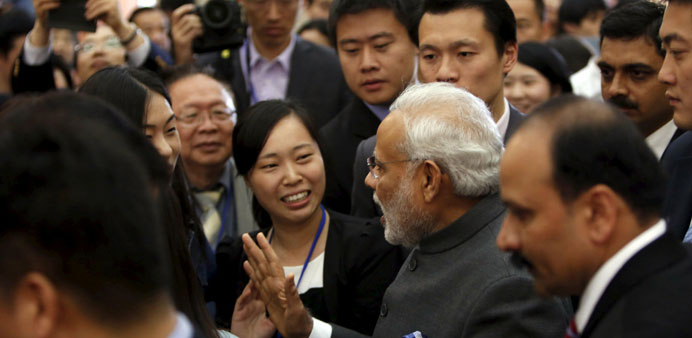
Prime Minister Narendra Modi talks with students at Fudan University in Shanghai yesterday.
AFP/Shanghai
Prime Minister Narendra Modi got down to business on the final day of his trip to China yesterday, saying India was open for investment as firms signed deals worth more than $22bn.
“Let us work together in mutual interest and for progress and prosperity of our great countries,” Modi told executives from 200 Chinese and Indian companies at a business forum in the Chinese commercial hub Shanghai.
“Now India is ready for business.”
Modi was on the final day of a three-day trip to China, as the two jockey for regional influence and India’s trade deficit with China balloons.
Despite his hardline reputation, Modi has moved to engage with Beijing since his election last year, and he was looking for an economic boost from the visit, seeking to deliver on election promises for foreign investment.
China is India’s biggest trading partner with two-way commerce totalling $71bn in 2014. But India’s trade deficit with China has soared from just $1bn in 2001-02 to more than $38bn last year, Indian figures show.
Indian embassy trade counsellor Namgya Khanpa said the 21 agreements signed at the Shanghai event were “worth over $22bn,” with another five exchanged earlier.
Many of the contracts were for Chinese banks to finance Indian firms, and also included deals in the telecom, steel, solar energy and film sectors, she said.
They included an agreement for the China Development Bank to fund a power plant for India’s Adani Power, as well as a steel project between Indian conglomerate Welspun and two Chinese firms, according to a list released by Indian officials. No individual deal values were given.
Modi welcomed potential Chinese investment in sectors including housing, renewable energy, high-speed rail, metro, ports and airports, adding that India was eager to draw on China’s expertise in mass manufacturing.
“We are very keen to develop the sectors where China is strong,” he told the business forum ahead of the signing ceremony. “We need your involvement.”
“I strongly believe that this century belongs to Asia,” he said as he sought to stress historical links between the two countries.
But they have followed significantly different economic paths in recent decades, with China rising to become the world’s second-largest economy while India has lagged behind, although Modi’s election raised hopes for reform among investors.
Earlier during Modi’s visit Chinese President Xi Jinping welcomed him in Xian, the capital of his ancestral home province Shaanxi, in what his host said was an unprecedented gesture.
Nonetheless relations between the world’s two most populous nations are soured by a long-running border dispute that saw them fight a brief war in 1962, and on Friday Modi told Prime Minister Li Keqiang that China needs to “reconsider its approach” to their ties.
“Our relationship has been complex in recent decades,” Modi said in Beijing, adding there were issues that “trouble smooth development of our relations.”
His comments stood out from the usual public declarations by diplomatic visitors to the Chinese capital, who normally stick to uninterrupted pledges of friendship and good relations.
Both countries are members of the BRICS grouping of major emerging economies, but China has vowed to pour investment into Pakistan as it rolls out infrastructure development plans across Asia, much of which bypass India.
Yesterday, Modi also opened a centre for Indian and Gandhian studies at prestigious Fudan University.
Modi, elected in a landslide victory at polls a year ago, said on Friday that democracy was an advantage for his country, but when a group of Indian students studying at Fudan chanted his name as he arrived, suspicious Chinese security guards moved towards them before being waved off.
“We just wanted to greet him,” one of the students said.
Modi left China late yesterday to arrive in Ulan Bator, where he will stay for one day as the first Indian prime minister ever to visit Mongolia, according to a tweet by the external affairs ministry.
Modi vs Singh: both globetrotters
Prime Minister Narendra Modi is executing his “fast-track diplomacy” - as his government calls it - with gusto: including his current China visit, he will have been abroad for 53 of 365 days in 17 countries. That’s not very different from his predecessor Manmohan Singh, who spent 47 of 365 days in 12 countries during the first year of the second term of the United Progressive Alliance, or UPA-II (and 30 days during UPA-I). Modi promised a strong foreign policy to the people of India after he took oath on May 26, 2014. The swearing-in ceremony was attended by leaders from eight neighbouring nations. But there is a striking difference between the two prime ministers: Modi has made more state visits - official visits to countries - compared to summit-oriented visits by Singh. Modi has been criticised for his foreign visits and days spent out of the country. But Singh was nearly as well travelled as Modi, in terms of days abroad.