


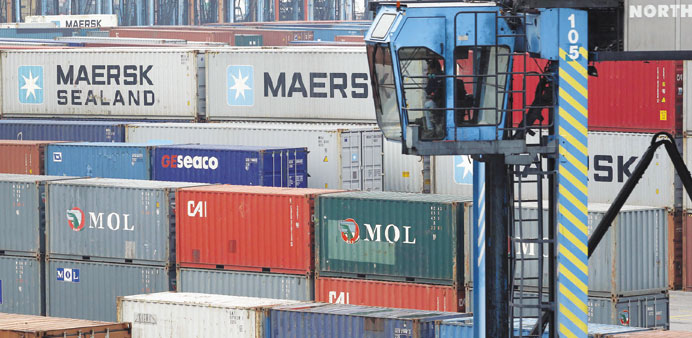
Shipping containers are stacked at North Point in Port Klang, Malaysia. Malaysia’s economy posted 5.6% growth in the first quarter, beating forecasts and just a tad slower than the previous quarter, as it showed resilience in the face of weak global prices for energy and commodity exports.
Reuters/Kuala Lumpur
Malaysia’s economy posted 5.6% growth in the first quarter, beating forecasts and just a tad slower than the previous quarter, as it showed resilience in the face of weak global prices for energy and commodity exports.
After releasing the data, Bank Negara Malaysia’s Governor Zeti Akhtar Aziz said the Southeast Asian economy was diversified enough to weather the fall in prices for natural gas and oil – Malaysia is the world’s second largest gas exporter and is still, if only just, a net exporter of crude.
“We remain resilient,” Zeti told a news conference. “We will be affected by price movements of energy and fuel prices, but it’s not going to devastate our economy.”
Exports were subdued at the start of the year, but a surge in March, led by electronics, raised expectations that Malaysia’s growth story remained intact, despite political ructions over the $11bn debt at 1MDB, a sovereign wealth fund chaired by Prime Minister Najib Razak.
Like many analysts, Wellian Wiranto, economist at OCBC in Singapore, took comfort in the first quarter growth that surpassed a Reuters poll forecast for 5.5%, and was just below a revised 5.7% growth for the previous quarter.
“It’s a number that will make Malaysia watchers sleep better at night,” Wiranto said.
Growth might have been slower but for a surge in industrial activity and robust private consumption in March prior to the implementation of a new 6% goods and services tax (GST).
“A host of challenges remain for Malaysia’s economy this year, including post-GST adjustment, oil price volatility and episodes of political drama,” Wiranto said.
While expecting the tax to crimp consumer spending going forward, Zeti was confident that the damage would be limited.
“Domestic demand remains the key anchor to growth,” she said. “Private consumption will moderate as households adjust to the GST, but consumption is expected to be supported by the rise in income and employment.” Najib may try to soften the GST blow by announcing steps to raise living standards when he presents the government’s next five-year economic development plan on May 21.
A bounce in oil prices from the 6-year lows seen in January has dispelled some of the earlier worries that Malaysia’s current account surplus could dwindle to risky levels.
Data released yesterday showed the surplus bounced back to 10bn ringgit in the first quarter from a revised 5.7bn ringgit in the previous quarter. Earlier fears that Malaysia could suffer heavy outflows of foreign capital once US rates rise have largely faded, and net outflows of portfolio investment fell to 7.9bn ringgit in the first quarter, after a worrying outflow of 20.3bn in the previous three months.