


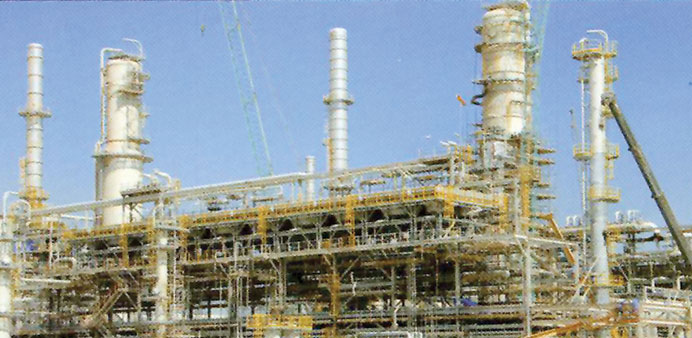
LR2 under construction at Ras Laffan. The project will double the condensate refining design capacity of the Laffan Refinery to 300,000 bpd, solidifying Qatar’s position as the largest condensate producer with the largest condensate refining capacity in the world. PICTURE: Qatargas’ The Pioneer magazine
By Pratap John/Chief Business Reporter
The completion of Laffan Refinery 2 (LR2) construction works in the third quarter of 2016 will help Qatar gain capacity to process approximately 40% of the condensate from the gigantic North Field.
LR2 will effectively double the condensate refining design capacity of the Laffan Refinery Complex to 300,000 bpd, solidifying the country’s unique position as the largest condensate producer with the largest condensate refining capacity in the world, Qatargas said.
“The Laffan Refinery Project aims to build a bridge between present and future generations by optimising Qatar’s natural resources and fostering sustainable growth,” Qatargas said in the special edition of its journal ‘The Pioneer’.
LR2 is a joint venture between Qatar Petroleum (QP), Total, and Japanese energy companies Idemitsu, Cosmo, Marubeni and Mitsui.
As with LR1, Qatargas will operate LR2.
The LR2 project, located at Ras Laffan Industrial City, will add to Qatargas’ integrated value chain and will generate revenue from supplying the refined products into domestic and export markets.
HH the Emir, Sheikh Tamim bin Hamad al-Thani formally laid the foundation stone for Laffan Refinery 2 in April 2014.
Qatar’s ambition to build the world’s largest condensate refinery was achieved when Laffan Refinery 1 (LR1) was officially opened in September 2009, helping to capture synergies and opportunities from the development of the North Field, Qatargas, RasGas and other Ras Laffan City ventures.
The refinery consists of processing units including utility systems, distillation units, naphtha and kerosene hydrotreaters, a hydrogen unit and a saturated gas plant producing naphtha, kerojet, gasoil and liquefied petroleum gas (LPG) from untreated gas condensate.
From its inception, the refinery was planned as an environmentally-friendly facility and was built in line with stringent standards to reflect this concept in every detail. One such system is the gas recovery system, which captures and compresses gases generated during normal operations and recycles them as fuel gas.
Furthermore, the refinery’s waste water treatment system enables the reuse of treated water in various operations of the refinery. Under this system, as much as 40% of the effluent water is treated with the overall treatment capacity of the plant being 40 cu m per hour.
“The emission levels at the refinery are also low because of advanced environment control programmes introduced within the facility that meet European Union standards,” Qatargas said.
Qatargas operates the refinery on behalf of the shareholders: QP, Total, ExxonMobil, Cosmo, Idemitsu, Mitsui and Marubeni.
Since the start-up of LR1 and the Receiving and Loading Facility (RALF), Qatar has not imported any diesel from outside the country.