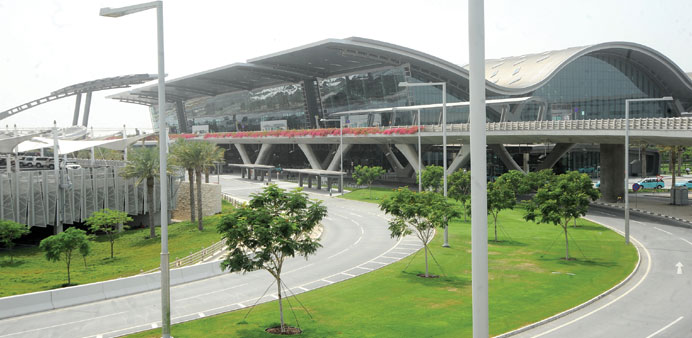
The new Hamad International Airport in Doha. QIF says the Chinese style infrastructure upgrade promises to drive Qatar’s economy at a “super-normal” pace for 5-7 years as it scales up its infrastructure for both the 2022 World Cup and, concurrently, building a strong non-hydrocarbon economy.
By Santhosh V Perumal/Business Reporter
Qatar, a late but stable developer among hydrocarbon states, is expected to witness “super-normal” pace for the next 5-7 years on the back of “Chinese style” infrastructure upgrade but dollar strength could undermine the competitiveness of its non-oil economy, according to Qatar Investment Fund (QIF).
The 2022 FIFA World Cup is largely an “irrelevance” except that the deadline provides an incentive for Qatar to complete its infrastructure build-out and press on with plans to further reduce its dependence on gassy hydrocarbon revenues, said QIF, which has outperformed the market over one, three and five years on a relative and risk adjusted basis.
Post 2022, Qatar’s economic growth is expected to subside to a more sedate 3-5% per annum (pa) in real terms as growth drivers migrate from infrastructure driven capital investment to a diversified services oriented economy, possibly with significant niches in Islamic tourism, medicine and education, it said.
QIF said the Chinese style infrastructure upgrade promises to drive the economy at a “super-normal” pace for 5-7 years as it scales up its infrastructure for both the 2022 World Cup and, concurrently, building a strong non-hydrocarbon economy (infrastructure, sports, medicine, Islamic tourism and education) to complement its hydrocarbon economy.
Finding that “Qatar’s natural gassiness and lack of oil makes it a late but stable developer amongst the hydrocarbon states”; it said while impacted by hydrocarbon price volatility, its natural cyclicality is dampened by long term contracts, the state’s relative parsimoniousness and a determination to develop its non-hydrocarbon economy (currently 50.5% of nominal gross domestic product or GDP).
“Over the next 5-7 years, Qatar’s growth will be dominated by non-hydrocarbon economy (growing at 9-10% pa) as the country (which exported its first gas 20 years ago) builds out its infrastructure for the next stage of its growth,” said QIF, which is currently trading on a 17.4% discount and yielding 2.7% and trading at its 12-month average dividend at an average of 9% per annum (pa) for the last three years. QIF offers investors focused exposure to the non-hydrocarbon economy (short-medium term GDP growth of 9-10%pa) and, specifically, the core macro trends such as population growth, expansion of private sector credit and business opportunities associated with the infrastructure build out.
Qatar’s economy is underpinned by 13% of the world’s natural gas reserves, 84% of which is exported in the form of liquefied natural gas of which c90% is subject to long term contracts between 2014 and 2020.
QIF highlighted that the country’s non-hydrocarbon economy was being driven by infrastructure capex as Qatar executes its 2030 plan to diversify the economy (a programme that has been accelerated by the 2022 World Cup) and that its current rate of growth (9-10% pa) would continue for a number of years.
The Qatar Stock Exchange offers direct exposure both to the country’s non-hydrocarbon economy (growing at 9-10%pa) and indirect exposure to the hydrocarbon economy (via the services sector), it said.
The key catalysts are strong (9-10% pa), medium term, non-hydrocarbon economic growth, undemanding valuations and strong and active discount control mechanisms; even as risks are “significant further deterioration” in the stability of the Levant that could negatively impact the Middle East and the continuing dollar strength that could undermine the competitiveness of Qatar’s non-hydrocarbon economy.