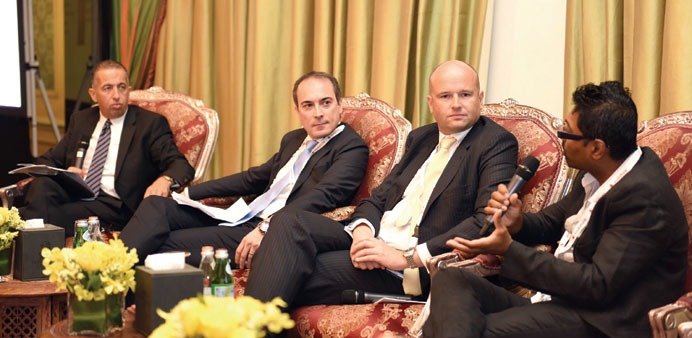
Devoteam managing partner Osama Ghoul (left) moderates the panel discussion on “Digital Transformation: A Long Journey that Needs to Start Now.”
Economic growth and improved living standards could be achieved if economies in the Middle East region would embrace the digital revolution, an expert in information communications technology (ICT) said during the “Beyond Connectivity 2015” summit hosted by Samena Telecommunications Council in Doha.
“Digital technology is the single most important factor in enhancing productivity. Countries that adopted the digital agenda managed on average to enhance productivity by more than 40% over the last five years, which meant that their citizens are enjoying better living standards than other countries that did not adopt the digital agenda.
“It is clear, therefore, that one of the means to bridge the gap between regional economies and the economies of the developed countries is to embrace the digital revolution,” said Osama Ghoul, managing partner of ICT service provider, Devoteam.
Ghoul, who moderated the discussion on the topic “Digital Transformation: A Long Journey that Needs to Start Now,” said while the Middle East region has been witnessing several initiatives towards adopting the digital agenda, “these remain largely in the envisioning stage.”
“Growing the economy is a primary objective of the countries in the Middle East. A major approach to do that is by increasing the productivity of their citizens, organisations, and establishments.
“Increasing productivity has a major impact on citizens’ standard of living, especially if we consider that a small increase of 4% in productivity would double living standards every 17 years,” said Ghoul.
He added, “We believe that the proof of the pudding will be in the execution and the associated change management culture that will embrace the use of the digital agenda for the benefit of people and communities.”
The “Beyond Connectivity 2015” summit was held under the theme, “Meeting the Digital Agenda: “Maximizing Telcos’ Revenues through Harmonised Excellence” and gathered senior decision-makers from the region’s leading telecom operators, technology providers, and government and industry bodies.