


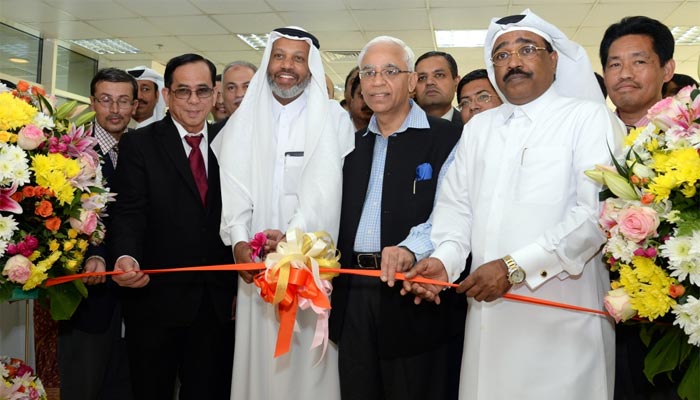
Senior officials of NHRC and dignitaries from four expatriate communities in Qatar led the official opening of the help desks. PICTURE: Thajudeen.
By Joey Aguilar
Staff Reporter
Qatar’s National Human Rights Committee (NHRC) inaugurated four help desks on Tuesday as it aims to build bridges of communication with various expatriate communities in the country.
Help desks of India, Nepal, Egypt and the Philippines have been established at the NHRC building (ground floor) manned by representatives from the four expatriate communities.
In his speech (read by NHRC’s International Cooperation Division head Saad Sultan al-Abdulla), NHRC chairman Dr Ali bin Samikh al-Marri said they wanted to continuously spread human rights awareness in Qatar which had a large number of foreign workers.
NHRC wants to reach out to people who have difficulty accessing the services available to them whether due to working hours, transportation costs, language difficulties, legal fees or fear of raising a complaint.
Al-Marri pointed out that the move is just the first stage of the initiative aimed at further promoting and protecting human rights in the country.
“These desks you see today are not simply desks, they are also a symbol of NHRC's openness to the constructive contributions of migrant communities in Qatar and a commitment to a continued engagement with you,” he stressed.
NHRC also saw the need to have help desks to easily address various human rights issues and concerns lodged by workers.
Al-Marri said the representatives nominated by their respective embassies in Qatar will have a more official role and representation with them.
He sees these representatives to function as a communication channel with their respective community populations.
“It will reflect the problems faced by members and to suggest practical and creative approaches and solutions,” he added.
Echoing the statements of al-Marri, Philippine labour attaché Leopoldo De Jesus told Gulf Times that many expatriate workers like Filipinos will benefit from NHRC’s initiative.
He said his compatriots will be more aware of their rights and the resolutions of their concerns and complaints.
According to De Jesus, the help desks could be an extension of services for overseas Filipino workers, complementing the role of the Philippine Overseas Labour Office in Doha.
“At least they have the Ministry of Labour, NHRC, Labour Court, and the embassy to deal with their concerns,” he said.
About the representatives, the labour attaché noted that these volunteers have the time, credibility and knowledge to attend to the concerns of their compatriots.
Legal experts at the NHRC can speak English fluently, and De Jesus hopes that the volunteers can speak Arabic as well.
Besides the four help desks, the NHRC is looking forward to establish more offices for other communities in the future.
De Jesus and other dignitaries including Indian ambassador Sanjeev Arora, Egyptian embassy counsellor Yasser Said, NHRC member/judge Fawaz al-Jathaal and members of the four expatriate communities attended the event.