


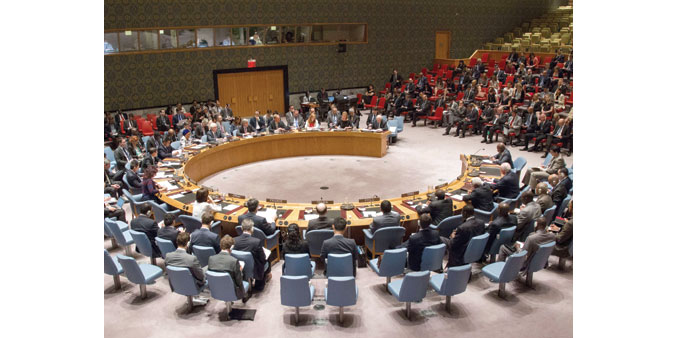
Mogherini (seated second from right, facing the camera) addresses the UN Security Council meeting on co-operation between the United Nations and regional and sub-regional organisations in maintaining international peace and security.
Reuters/AFP
United Nations
Europe appealed to the United Nations Security Council yesterday to back its plans to stem the flow of migrants across the Mediterranean and pledged that those intercepted at sea while making the precarious trip would not be repatriated.
European Union leaders agreed last month to “identify, capture and destroy vessels before they are used by traffickers” but it is unclear how that may be achieved and the 28-nation bloc wants UN authorisation for its operation.
EU foreign policy chief Federica Mogherini told the Security Council that details of the operation were still being worked out and the issue would be discussed by European foreign ministers on May 18.
“We cannot do it alone, this has to be a common global effort, that’s why we count on your support to save lives and dismantle criminal organisations that are exploiting people’s desperation,” Mogherini told the 15-nation council. “No refugees or migrants intercepted at sea will be sent back against their will.”
European members of the Security Council – Britain, France, Lithuania and Spain – are drafting a resolution to approve the European operation under Chapter 7 of the UN Charter, which allows the use of force, diplomats said.
But Russia has said any plans to destroy boats used by smugglers would be “going too far”.
“Our first priority is to save lives,” Mogherini said. “An exceptional situation requires an exceptional and co-ordinated response.
“It is not only a humanitarian emergency, but also a security crisis since smuggling networks are linked to and, in some cases, finance terrorist activities.”
About 1,800 migrants have perished in the Mediterranean this year, the UN refugee agency said.
Some 51,000 have entered Europe by sea, with 30,500 coming via Italy, fleeing war and poverty in Asia, Africa and the Middle East.
Most of the migrants are travelling to Europe through Libya, which has descended into chaos nearly four years after the fall of Muammar Gaddafi. Two competing governments backed by militia are scrambling for control of the oil-producing country.
Europe wants to win the support of the parties in Libya for its plan to tackle the migrant smuggling.
The group controlling Libya’s coastal capital Tripoli said it would “confront” any unilateral EU moves to attack sites used by traffickers.
“We don’t and won’t act against anyone, but in partnerships with all,” Mogherini said.
Human rights and aid organisations have also come out against military action, arguing that attention should focus instead on broadening legal avenues for migrants to reach Europe.
At a summit last month, EU leaders agreed they had to act in face of the mounting death toll, committing more money for search and rescue missions and to extend their scope.
They also tasked Mogherini with drawing up a list of military options, including action to capture and destroy the smugglers’ vessels.
The migrant issue is hugely sensitive as the EU agonises over how best to respond, with eurosceptic and nationalist parties capitalising on public unease over increased immigration.
Tomorrow European Commission head Jean-Claude Juncker is due to present a new migration policy plan which includes a provision that distributes the migrant burden more fairly across the bloc.
The proposals, a draft of which Reuters has seen ahead of its planned release tomorrow, have won the backing of France and some other countries, but they will require the support of all 28 member states, which is far from certain.
The plans have drawn criticism from a political grouping in the European Parliament dominated by British Prime Minister David Cameron’s newly re-elected Conservatives, and Hungary’s Prime Minister Viktor Orban has called them “mad”.
The Commission aims to relocate migrants to other member states based on the size of a recipient’s economy, its population, its unemployment rate and its past numbers of asylum seekers.
“The EU should not wait until the pressure is intolerable to act: the volumes of arrivals mean that the capacity of local reception and processing facilities is already stretched thin,” the draft reads.
Asylum applications in the 28-nation bloc hit a record of some 600,000 last year.
The Commission says it wants to reduce the incentives for people to move to Europe and to crack down on trafficking gangs, including operations to destroy their vessels.
By the end of May, the Commission will also propose an EU-wide resettlement scheme that offers places to would-be immigrants currently living outside the EU.
The United Nations High Commissioner for Refugees has suggested that the EU offer 20,000 such places per year by 2020.
The legislation planned by the end of 2015 will in addition seek to attract highly-skilled migrants to alleviate anticipated labour shortages.
Responding to the Commission proposals, British Conservative Timothy Kirkhope, a member of the European Parliament and former UK immigration minister, said EU action should focus on saving lives and stabilising the region.
Some countries should do more to help, he added, but in a spirit of solidarity, not because of a compulsory EU quota.
For some European governments, taking in more people only makes the problem worse, arguing that it attracts other migrants into risking their lives on the risky Mediterranean crossing.
“Juncker wants a required quota of refugees but this is practically seen as a declaration of war” by certain member states, one top European official said.
Germany, however, has argued for a humanitarian response to the disaster by spreading the refugees more fairly among member states.
In terms of the military response, diplomatic sources say current thinking would allow EU navies to board unflagged vessels in international waters in the Mediterranean to stop people traffickers, but they would not intervene before they left the Libyan coast, as the summit had suggested.
The Europeans believe they can act without a UN mandate against ships that fly no flag, which enjoy less protection under the law of the sea. But they would need the UN’s approval to go into Libyan territorial waters.