


ADP/DPA
Belgrade
Thirty alleged gunmen were charged yesterday with terror offences after a bloody shootout with Macedonian police which left 22 dead, including eight police officers, and dozens of homes destroyed in a town close to the border with Kosovo.
The suspects face a 30-day detention for charges that include “conspiring to undermine the constitutional order and security”, a “hostile act” and possession of illegal firearms, a court in the capital of Skopje said.
Eighteen of the suspects are nationals of neighbouring Kosovo, while all appear to be ethnic Albanians.
Most admitted to illegally entering Macedonia, the court said.
The clashes in Kumanovo at the weekend were the worst in Macedonia for 14 years, and raised fears of a fresh conflict similar to the country’s 2001 ethnic conflict.
But the opposition and analysts suggested the timing of the violence – with the government under huge pressure over a series of alleged misdemeanours – was suspicious.
In the district where the shootout took place – several dozen houses and around a dozen small narrow streets populated by both Macedonians and ethnic Albanians – signs of large-scale destruction were everywhere to be seen.
Cars and houses were destroyed, with some completely burned down, and a large amount of debris lay on the ground, while broken windows and bullet holes were visible on almost every house in the district.
Burning could still be smelled midday yesterday in the area as dozens of people who had fled their homes started to return, while some from other parts of Kumanovo came to see what had happened.
Basti Ramadan, a 77-year old Albanian, stood in despair in front of his house, whose roof and upper floor were burned down.
Cartridge cases were scattered around the entrance of the house.
“I was awaken by grenades early on Saturday morning. I immediately went to the basement with my family and we hid there until police came in the evening,” Ramadan told AFP.
“We were taken to Skopje for questioning and released only on Sunday morning. When we came back we found our house destroyed and robbed, I saw blood stains in a room on the floor,” the old man said in disbelief.
Macedonian Prime Minister Nikola Gruevski claimed a “particularly dangerous terrorist group” of ethnic Albanians had been planning a major attack in the Balkan country.
Eighteen of the 30 men charged were ethnic Albanians from neighbouring Kosovo, the prosecutor said.
Leaders of the breakaway territory’s top leaders condemned “any involvement” of Kosovans in the deadly shootings.
The incident came less than three weeks after around 40 Kosovo Albanians briefly seized control of a police station on Macedonia’s northern border, demanding the creation of an Albanian state in Macedonia.
The largest Albanian party in Macedonia, DUI, which is also Gruevski’s coalition partner, led by former guerrila leader Ali Ahmeti, said in a statement that the “security incidents in recent months are not in line with our strategic orientation and do not represent the interest of the Albanian nation in the country and in the region”.
The shooting erupted on Saturday at dawn when police moved in on the armed group. Eight officers were killed and 37 injured, while 14 bodies were found at the site.
Ethnic Albanians make up around one-quarter of Macedonia’s 2.1mn population.
The 2001 Macedonian conflict with ethnic Albanian rebels ended with an agreement providing more rights to the minority community.
However, relations between ethnic Macedonians and Albanians remain strained.
Many questions about the police operation were raised.
Some of Kumanovo’s inhabitants, both Macedonians and Albanians, told reporters that they had “no idea” who the gunmen were or where they came from.
“All this is created by the authorities,” an Albanian in his 40s, who did not want to reveal his name, told AFP.
“Gruevski thinks this is going to save him, but his days (in power) are over as on May 17, the people will say their word,” he said, referring to a rally planned by the main opposition Socialist SDSM opposition party scheduled for Sunday.
His Macedonian neighbour, who also wanted to remain anonymous, echoed his words.
“This is how Gruevski solves problems, but his power will end” after the rally, the 58-year-old man said.
The violence in Kumanovo erupted as Macedonia is embroiled in a deep political crisis.
Gruevski’s government is accused by the opposition of wiretapping, covering up murder and million-euro bribes.
Some analysts also questioned the timing of the deadly clashes in Kumanovo amid growing discontent with the government that has faced mounting street protests.
“It’s very suspicious, just when the public opinion seems to be turning against the government, suddenly there is a terrorist threat,” said James Ker-Lindsay a South East Europe researcher at the London School of Economics.
“This is not to say there is no terrorist threat, there could be... but the trouble is that the trust in the government is so low now that even people who usually don’t buy into Balkan conspiracy theories cannot dismiss the idea that maybe this was orchestrated,” he told AFP.
Petar Silegov, of the SDSM, said the Kumanovo violence would not deter the SDSM from continuing with anti-government protests, including Sunday’s rally.
President Gorge Ivanov, Gruevski’s ally, presented Nato, EU and US representatives in Skopje with the government’s account of the Kumanovo incident, his office said.
EU Enlargement Commissioner Johannes Hahn urged “all involved parties and actors to collaborate in clarifying what has happened”, but warned that Macedonia’s political crisis must be resolved.
“This attack, this event cannot and should not distract from the very serious internal political situation ... we have urged the government, but also the opposition party, to start resolving it, to start co-operating,” he said.
Nato Secretary General Jens Stoltenberg has called for a “transparent investigation” of the incident.
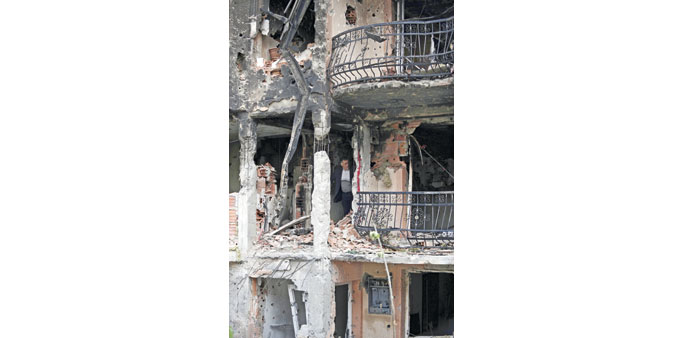
A man walks through his damaged apartment in Kumanovo yesterday.