


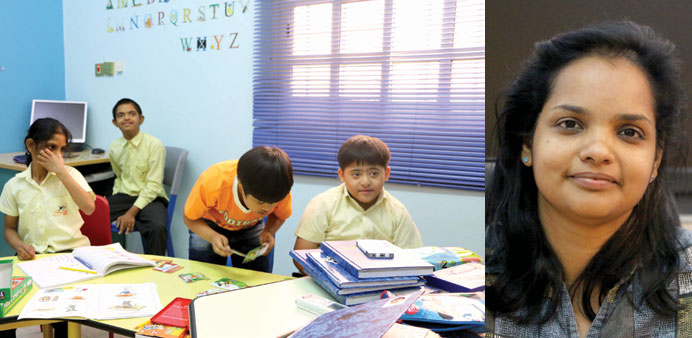
BUSY BEES: Children carry out educational activities in the classroom. Right: DETERMINED: Ciby Mathew is the Director of HOPE Qatar. Photos by Umer Nangiana
By Umer Nangiana
HOPE, indeed. They are creating hope, and thus a meaningful space for a segment of society that can otherwise easily lose hope and face social segregation. HOPE Qatar, a non-profit organisation, has been providing affordable training to children with special needs for the last 10 years.
Working essentially as a training centre, it is moving ahead with ambitious initiatives focussed on specific projects and programmes that enhance its service to children under its care, and strive to reach even more in need.
Having commenced in the year 2005, HOPE Qatar has become a pioneer in providing help, opportunity, participation and education to children with special needs to bring out the best in them.
“We are trying to give them a normal school environment here and do whatever is being provided at normal schools. In fact, some of the children have been incorporated into the normal schools,” Ciby Mathew, Director of HOPE Qatar, tells Community in an interview.
“The seniors at the centre are writing their 10th grade exams right now. We got some job offers from some banks and we hope that we get more such offers and our children are able to join some,” she enthuses.
A dedicated team at HOPE Qatar believes that each child comes with unique potential. It is up to us to give them the opportunity to rise and shine so that they are nurtured into becoming valuable members of the community they live in.
“The developments and changes that we notice in each child studying under our care is an indicator of our successful approach and programmes,” Ciby points out.
“We currently have children from mild to moderate disabilities. So we evaluate them and if they are able to fit into the group, we take them. We are not able to take more than six or seven in a class in order to give them the attention that they need,” explains Ciby.
“We are also planning to start evening classes and hire some people for it. Currently, the space is enough but we are trying to broaden the space so that we can accommodate more children,” adds the director.
The training centre aims to provide effective educational training to children with mild to moderate disabilities, to teach and train children in the class according to their individual education plans and, to train teachers for continued professional development as per requirements.
They also target to provide parent counselling when required on how they can help to bring out the best in their children with special needs.
“People feel shy and ashamed for some reason, I don’t know, in going to a special school. Many parents are facing that problem and it is very unfortunate,” says the director.
“I do not and cannot force the parents. I ask them only if you are happy, you let your children come to us because only if their mind is free, it will happen. If it is not free, it would be difficult for them to start and continue,” says Ciby, who is a doctor by profession.
Her own son studies at the centre and he was partly the force that motivated her to start HOPE Qatar as she realised, from first-hand experience, the needs of children with special needs and that of their parents.
Today, Hope endeavours to create awareness in society about the needs and potential of children with special needs, to create opportunities for the integration of children who are ready to attend mainstream schools and to allow volunteers to come and work with the children.
It is also trying to participate with corporate organisations to develop and deliver programmes that create awareness and also benefit children with special needs.
HOPE’s methodology is simple and straightforward as they believe that one solution does not fit all and thus their approach is specifically tailored to meet the specific requirements of each child under their care.
The methodology which primarily focuses on functional academics works in such a fashion that there is a systematic evaluation of each child, preparation of individual education plans and delivery through a combination of special education and Montessori techniques.
It is a combination of classroom studies and practical training aimed at real life experiences. The capping of a single class at seven students ensures personal attention of the teacher at all times, regular interaction with parents and enhancing a child’s ability in order to overcome his or her weaknesses.
The centre charges minimal fee from parents but Ciby says the organisation is largely dependent on donations. “Yes, we do get donations, but now it is getting very difficult. The rent is getting very high and it is becoming difficult to run this organisation,” she adds.
They have children from many nationalities, but mostly from India, Pakistan, Sri Lanka and the medium of teaching is English.
Ciby recalls that the centre began from a small facility with makeshift rooms. It has developed over time. The children at the school have been developing their mental abilities all along.
“I am happy for what I have done. It is only that financially it is becoming difficult to run the organisation. I really don’t know what to do. I think there are more laws coming in on barring bigger financial organisations from giving money to individuals,” says Ciby.
“I think for the banks, there is a rule that they can only donate to a registered NGO and we are not a registered NGO, so they can’t help. So there are only small donors left and they have their own difficulties, but I am approaching as many as I can to keep the centre running,” says the director.
Right now, they have three classes based on the children’s growth and development and the senior students are writing Grade 10 exams right now.
“They all have different needs so we teach them accordingly. Some students have writing difficulties, but they become fine and I think all of them are writing like normal children now. So we do not require special assistance for them in that case,” says Ciby.
At HOPE Qatar, a systematic and regular evaluation process enables the monitoring of the progress of each child at individual and group levels. Constant feedback from teachers and the team ensures that parents are updated regularly about the progress of their children and further programmes are developed on an ongoing basis in consultation with them and the special educators.
This ensures that the development of the child becomes a collective responsibility and the training continues beyond the classrooms on an ongoing basis.