


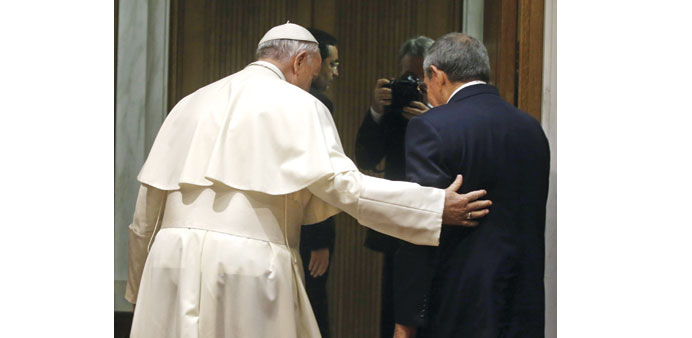
Cuba was slowly “trying to move forward with perfecting our political, cultural and economic system,” he said, adding that it was “difficult because we do not want to take measures that hurt our people. We don’t want any shock measures. We don’t want Pope Francis walks with Castro during a private audience at the Vatican yesterday.
Reuters/AFP
Vatican City
Cuban President Raul Castro thanked Pope Francis yesterday for brokering the thaw between Havana and Washington and said that the Pope so impressed him that he might return to the Catholic Church, despite being a communist.
The 83-year-old younger brother of Cuba’s revolutionary leader Fidel spoke with the Argentine-born Pope for nearly an hour – unusually long for a papal meeting – during a meeting the Vatican said was strictly private and not a state visit.
Papal audiences on Sundays are extremely rare.
Francis made an exception when Castro asked if he could stop in Rome on his way back from Moscow to thank Francis for the Vatican mediation between the United States and Cuba, Cuban officials said.
Leaving the meeting, Castro told reporters that he thanked the Pope for the Vatican’s contribution to December’s historic resumption of diplomatic relations between the former foes after more than half a century of antagonism.
During the meeting Castro offered the Pontiff a painting by Cuban artist Kcho inspired by the plight of illegal immigrants stranded at sea – a subject close to the Pope’s heart.
Francis in turn presented Castro a medal of Saint Martin de Tours, a French saint celebrated for having given his coat to a beggar, and urged others to “clothe and support the poor”.
Castro was accompanied by his foreign minister Bruno Rodriguez Parrilla.
Their discussions, conducted in Spanish, were described by the Vatican as “very cordial”.
Later, at a news conference with Italian Prime Minister Matteo Renzi, Castro said that he came out of the meeting with the Pope “really impressed by his wisdom and his modesty”.
“When the Pope comes to Cuba in September, I promise to go to all his Masses and I will be happy to do so,” he said, adding that he reads all of the speeches of Latin America’s first pope, who has made defence of the poor a major plank of his papacy. “I told the prime minister if the Pope continues to talk as he does, sooner or later I will start praying again and return to the Catholic Church, and I am not kidding.”
Both of the Castro brothers were baptised as Catholics.
Francis, who is due to visit both Cuba and the United States in September, is a member of the Jesuit religious order.
Castro joked that “even I am a Jesuit in a certain sense” because he was educated by the Jesuits before the 1959 revolution.
The church’s activities were suppressed for decades after the revolution. The government began loosening restrictions in the early 1990s.
After the late pope John Paul visited in 1998, Fidel Castro re-instated Christmas as a holiday.
The Pope’s US trip had been planned for some time before the Vatican announced last month that Francis would stop in Cuba on his way to Washington.
It will be the Pope’s first visit to both countries as Pontiff. His predecessors John Paul II and Benedict XVI visited Cuba and met Fidel Castro.
Castro also said he was looking forward to Cuba being removed from the US list of state sponsors of terrorism, due to take place at the end of this month, saying: “We really should never have been on that list.”