


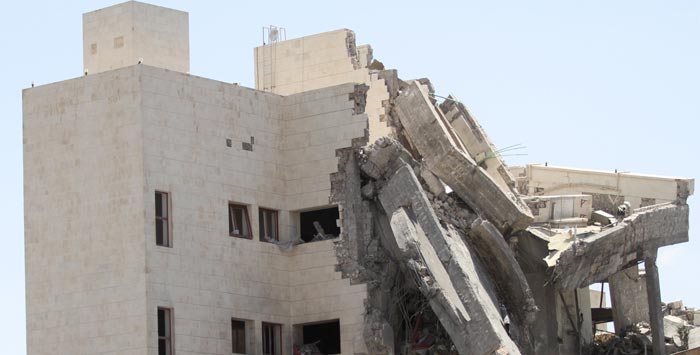
The residence of the Yemen's former president Ali Abdullah Saleh after airstrikes destroyed it in Sanaa on Sunday. Saleh and his family are safe after airstrikes targeted his residence in the capital Sanaa early on Sunday, a news agency allied to the former Yemeni president said.
AFP/Riyadh
The Saudi-led air war on Yemen was launched to foil a plot by a "sectarian group" to undermine security in the region, King Salman said on Sunday.
The Saudi monarch was defending the military operation Riyadh has led against Yemen rebels since March 26, in an address read to clerics on his behalf by an adviser in the Muslim holy city of Mecca.
The operation has prevented Yemen from "becoming a theatre for terrorism, discord, and internal fighting, similar to some countries," said King Salman, in remarks published by the official SPA news agency.
Saudi Arabia wanted to "support Yemen and confront the attempt to transform it into a base for launching a plot to undermine regional security and stability", he said.
The kingdom and members of the coalition began the campaign to "save Yemen and its brotherly people from a group entrenched with the spirit of sectarianism", Salman said, referring to the Shia Houthi rebels.
He said the rebels had "threatened neighbouring countries, especially Saudi Arabia, with backing from foreign parties seeking to spread their influence across the region and sow sedition", implying Iran.
This is an example of "using sectarianism to achieve political" goals, he said.
The Houthis were also "backed by internal Yemeni groups that broke their agreements," he said of Yemen's former president Ali Abdullah Saleh whose loyalists have been fighting alongside the Houthis.
Saleh resigned in 2012 under a Saudi-backed deal following a year-long uprising against his rule.
Riyadh responded to "this danger after exhausting all peaceful means to find a solution in Yemen," King Salman said.
Truce bid intensifies
Meanwhile, Yemen ceasefire efforts gathered pace on Sunday after more than six weeks of Saudi-led air strikes, with rebels saying they would respond "positively" and their allies accepting a US-backed truce plan.
The renegade troops said they had agreed to the five-day humanitarian truce that Riyadh has offered starting Tuesday.
The rebels did not refer explicitly to the Saudi offer, but expressed "readiness to deal positively with any efforts, calls or measures that would help end the suffering".
Amid the truce moves, a ship chartered by the UN's World Food Programme docked in the western port of Hodeida, bringing precious fuel to boost aid deliveries.
The MV Amsterdam brought 300,000 litres of fuel and supplies for humanitarian organisations, while a second vessel would bring an additional 120,000 litres later on Sunday.
The WFP's Yemen director Purnima Kashyap said the fuel will mean aid can reach "hundreds of thousands of people in need of urgent food assistance".
Coalition warplanes pounded the Houthi stronghold Saada in the northern mountains for a second straight night on Saturday after declaring the whole province a military target despite aid agency pleas.
Warplanes also launched twin strikes on the Sanaa residence of ousted president Ali Abdullah Saleh, who is accused of orchestrating the alliance between renegade army units and the rebels.
The renegade units, who remained loyal to Saleh after he was forced from power in early 2012, played a major part in the rebels' capture of swathes of the country beyond Saada in the mainly Shia northern highlands.