


with his thought provoking views on shaping young minds. By Umer Nangiana
All charismatic personalities in history have demonstrated through their acts that a great personal character comes with an unshakeable faith in virtue. Such firm belief is a prerequisite for developing an unsoiled superior character. Prominent Pakistani scholar, academician and TV personality, Syed Bilal Qutab, expressed these views during his lecture on ‘Character Building of Pakistani Youth’ at Pak Shamaa School here recently.
Attended by a large number of community members, the lecture was organised by Pak Art Society (PAS), a Doha-based socio-cultural and literary society of Pakistani expatriates. PAS has a long tradition of inviting well-known intellectuals and philosophers from Pakistan and organising highly informative and thought provoking lectures.
Stressing the importance of a parent’s role in the upbringing of children, Qutab, however, tossed a stimulating question as to what rules they can follow in such teachings. “There are no set principles of such training in the world. You would say theft is bad but you ask a thief and he would tell you it is good, a hoarder would say hoarding is good as it gives him profits and similarly a lender would say usury is good,” said the scholar.
Then, how should one decide between right and wrong? Qutab said there are two ways. “In this situation, one way is that you decide through the laws of a state. The other way is that God decides for you what you can do and what you cannot do,” added Qutab, quoting examples from history as how divine providence has been guiding different peoples in different times through God’s messengers.
Citing from known stories and events from both pre- and post-Islamic eras, the Pakistani scholar said that God has given human beings knowledge and intelligence, through his prophets, with which they gain the ability to analyse things and to differentiate between good and bad.
However, without character this knowledge cannot help them. “Character is the pre-condition for redeeming this knowledge, a great favour to you by the Almighty,” said Qutab, who is also an assistant professor at Department of Architecture in National College of Arts (NCA), Lahore.
Quoting from the life of Prophet Muhammad (PBUH), Qutab said that the messenger of God for the first 40 years of his life did not preach Islam but he was known for his strong character. Even the worst of his enemies would regard him as truthful and trustworthy. They used to believe in his words blindly and without a grain of doubt. It was the power of his character.
Qutab, who enjoys a sizeable following particularly among youth, first shot to fame with his programme Aalim Online on Geo TV. Since then, he has hosted similar format programmes across local language channels in Pakistan.
He is widely respected among Pakistani youth for his contemporary approach to argument and debate, and his extensive research on religion, philosophy and history. Before he was invited to take the podium, Qutab was quizzed by Shaber Ali, a prominent member of Pakistan Professionals Forum (PPF), in a segment called ‘Face-to-Face with Shaber’.
In this half-hour engagement, the Pakistani academician and scholar answered Shaber’s questions on what, he thinks, were the problems of Pakistani youth and how they could be best addressed with regard to their character building.
Qutab’s lecture was 27th in the series held by PAS. The society’s Chairman M A Shahid welcomed him to Doha on his first visit while PAS President Mohammad Abrar Hussain thanked him for his informative lecture.
The host Adeel Akbar invited Rashid Nizam, the Community Welfare Attaché of Pakistan embassy in Qatar, to present a shield to the visiting guest. At the occasion, Qutab presented copies of his book to the principal of Pak Shamaa School, Nabila Kaukab, for placing them in the school’s library.
In addition to his media career, Qutab is also a motivational trainer and human resource consultant associated with big names. He has taught at Boston University, USA.
His research paper Sustainability: A Muslim Perspective has been published by Edge Hill University, Lancashire, UK, and NCA, Lahore. He has also published a book Banam-e-Khuda, which is a collection of articles and lectures. At the conclusion of the event, the scholar interacted with the members of the Pakistani community.
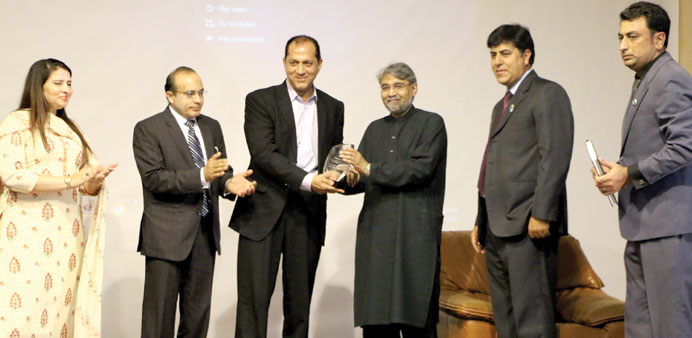
Rashid Nizam, CWA of Pakistan embassy, third right, presenting a shield to Syed Bilal Qutab.