


Reuters/Brasilia/Sao Paulo
Brazil Finance Minister Joaquim Levy’s four-month-old austerity plan is encountering growing resistance in Congress, as some legislators say his policies may deepen a looming recession.
This week, leaders in President Dilma Rousseff’s own Workers’ Party refused to pass a reduction in social welfare benefits designed to save the government 9bn reais ($2.9bn) this year.
Instead, the House of Deputies narrowly passed a watered-down version of the bill that reduced the measures’ estimated savings by at least 2bn reais.
Even though the Bovespa share index is up about 16% since Levy took office, the unemployment rate is still rising and so is the nation’s primary deficit, raising questions about whether his plan of budget cuts and tax increases will put Brazil’s finances in order after years of high deficits and disappointing growth.
“(Levy) is shooting himself in the foot,” Paulo Paim, a senior Workers’ Party senator who introduced many of the changes in the watered-down bill, said.
“I don’t think these measures will make us grow more in the future. They make the recession worse.”
Brazil’s economy has been stagnant for most of the past four years, and is expected to shrink 1.2% this year, according to the average forecast of economists in a weekly central bank poll. Rousseff’s generous spending and tax breaks in her first term left Brazil with an overall deficit of 7.8% of GDP in the 12 months through March, and contributed to annual inflation currently at 8.2%, well above the government’s 4.5% target.
The time has come for Levy to show austerity “was in fact necessary,” Leonardo Picciani, the allied Brazilian Democratic Movement Party’s (PMDB) leader in the lower house, said. “Once the house is in order, we need economic growth to come back.”
The finance ministry declined to comment. Levy has said the government’s “tremendous” austerity efforts will help the economy start growing again later this year as confidence and investment bounce back.
In the wake of the vote on the benefits-reduction bill, Levy on Thursday called the budget deficit the “biggest risk” to Brazil’s stability. He urged Congress to quickly approve further austerity measures or else “the costs will be higher.”
Economists have warned that, without cuts, Brazil would face an exodus of capital, higher borrowing costs for the government and families, and a possible currency crisis.
On the other hand, other countries have tried to narrow budget deficits at a time when economic activity is weakening, and it hasn’t worked out, either politically or economically.
“This is a path that has already been trodden by several developed economies since the global financial crisis - and their experience suggests that investors in Brazil should now brace themselves for a series of missed targets for deficit reduction,” according to a note from Capital Economics, a London-based consultancy.
Some pushback against unpopular measures was always expected. Indeed, Brazil has been down this road before.
In 2003, then-president Luiz Inacio Lula da Silva held off protests from the left wing of the Workers’ Party to push spending cuts through Congress. The savings restored investor confidence, and Brazil’s economy boomed in ensuing years, helped also by a surge in commodity prices.
This time, though, the challenge appears greater.
Unlike Lula, who was enormously popular, about two-thirds of Brazilians express disapproval of Rousseff in polls as unemployment rises and she deals with a corruption scandal at state-run oil company Petroleo Brasileiro SA.
The cuts themselves will also be deeper and longer-lasting. Alberto Ramos, an economist at Goldman Sachs, said it will likely be a “three-year process” to bring the primary surplus - its budget balance minus debt interest payments - back to 3% of gross domestic product, the level he said is needed to stop Brazil’s gross debt from rising further.
Ramos warned the austerity drive “has yet to start in earnest” - highlighted by the government’s posting of a primary surplus of just 239mn reais in March, well short of the 5.15bn reais analysts had expected.
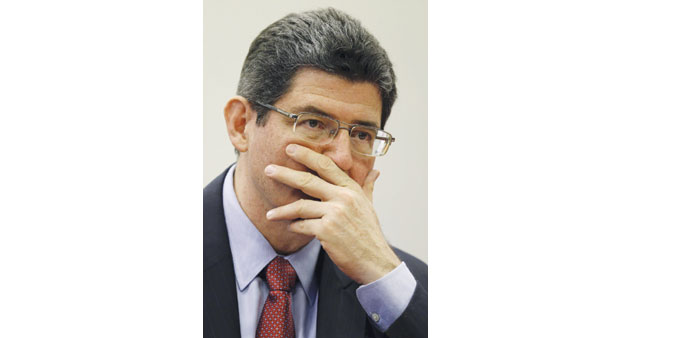
Joaquim Levy worried