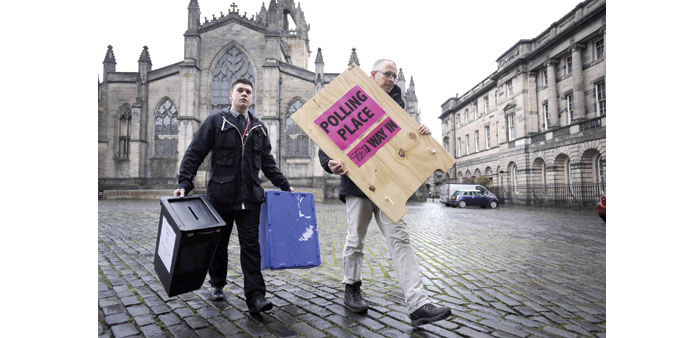
Polling manager Scott Russel (right) and assistant Ross Clement deliver ballot boxes and a polling sign to a polling station on The Royal Mile in the centre of Edinburgh yesterday.
DPA/London
Prime Minister David Cameron yesterday pleaded with voters to give him “five more years to secure our economy” as his rival, Ed Miliband, urged them to choose “a Labour government that puts working people first.”
Opinion polls showed Cameron’s Conservative Party inching ahead of Labour on the last campaigning day before parliamentary elections, but any last-minute swing was not expected to be large enough to give either party a majority of seats.
“Britain’s future is on a knife-edge,” Cameron, who has led a coalition with the Liberal Democrats since 2010, said in a Facebook message to voters.
“It would be a tragedy if we threw away all the hard work of the past five years and went back to square one,” he said.
Miliband said the election “comes down to a simple choice: between a Labour government that puts working people first, or a Tory government that works only for the privileged few.”
“We all know this race is going to be the closest we have ever seen,” Miliband said in his message.
“So in these final few hours, tell your friends, your family, your neighbours how important it is, that every single person in our country could make the difference,” he said.
A ComRes poll for ITV and the Daily Mail put the centre-right Conservatives on 35%, with centre-left Labour on 32%, the right-wing UK Independence Party on 14% and the centrist Liberal Democrats on 9%.
An average of four polls published on Tuesday showed the main parties even closer, with the Conservatives on 33.5% and Labour on 32.5%.
In an appeal published on the front page of the Daily Express, Ukip leader Nigel Farage urged people to “vote for change” and said it would be a “travesty” if his party fails to win more than the expected handful of seats, despite attracting up to 15% of votes.
“Every single vote for Ukip is a vote for change, a change in direction for our country but also a change in our voting system because the one we’ve got doesn’t work any more,” Farage said.
Cameron and several right-leaning newspapers repeated their warnings that a Labour minority government supported by the Scottish National Party would lead to “chaos.”
“There is so much more we need to do,” Cameron said in his message, claiming Labour had “helped to break our economy and they would do so again.”
In an interview with BBC Radio 4, he said the Conservatives “have 303 seats, (and) we need another 23 seats to form a majority.”
His optimistic forecast is 20 seats higher than most opinion-poll-based projections for the Conservatives.
Most analysts say 323 seats, rather than 326, are needed for a working majority in the 650-seat parliament because five members from the Irish nationalist party Sinn Fein refuse to sit in London.
In a telephone survey of 1,000 people by Usurv, 56% of respondents said the election campaigns had no impact on their voting intentions, with just 24% agreeing that the campaigns had some impact.