


Reuters/Barcelona
While Lewis Hamilton chases his fourth victory in five races in Barcelona this weekend, much of the immediate attention at the Spanish Grand Prix will be on a home hero with no hope of winning.
Bookmakers were last week offering better odds, before the birth, on Britain’s latest royal baby being named Macbeth than on Fernando Alonso’s McLaren team winning at the Circuit de Catalunya.
They are now a more reasonable 250-1 on the Spaniard, winner in Barcelona with Ferrari in 2013 and Renault in 2006, and team mate Jenson Button although just getting into the points for the first time this year will be a big step up for the ex-champions.
Alonso, who will attend an FIA news conference on Thursday, will be very much in the spotlight however on his return to the circuit where he crashed heavily in pre-season testing.
That accident ruled him out of the opening race in Australia and triggered all kinds of conspiracy theories about his condition and what had ‘really’ caused the crash.
Neither McLaren nor Alonso made any mention of the incident in their pre-race preview, preferring to focus on improvements they expect to see in the first race of the European season.
“I’m incredibly happy to be heading back to Europe, to my home country and racing in front of the loyal Spanish fans,” said Alonso. “We are seeing improvements race by race, and I want to ensure that we maintain this consistency throughout this weekend.
“Although we won’t be fighting for victory in Barcelona, I know I can count on the support of the fans to bring even more motivation during the whole weekend, which will be very special.”
PECKING ORDER
After a three week gap, the fifth round of the season will be closely watched for signs of any shift in the pecking order with teams bringing upgrades to their cars now they have had time back at the factory.
The battle at the front, however, is still likely to be between Mercedes, with double world champion Hamilton in commanding form, and resurgent Ferrari.
The Briton, who posted on Instagram a photograph of himself ringside at last weekend’s Floyd Mayweather v Manny Pacquaio welterweight unification bout in Las Vegas, is up for another fight.
“Having tasted success there (Barcelona) for the first time last year, I want to do it in even better style this time,” said 2014 winner Hamilton, who has a 27 point lead over teammate Nico Rosberg.
Mercedes motorsport head Toto Wolff added: “Lewis is in the zone right now, probably driving as well as he has ever done, and Nico showed his teeth in Bahrain with some forceful overtaking and a strong, aggressive race.
“We’re expecting more of the same in Spain.”
F1 struggling to tap the female dollar
When Claire Williams was appointed vice-principal of the Williams Formula One team, she hoped her promotion and the presence of Susie Wolff as test driver might open the door to an untapped market. With women making up some 40 percent of the audience, it seemed a good time to approach brands more interested in female consumers than the average petrolhead.
The response was hardly deafening: “I said (to the Williams sponsorship people) ‘Let’s go out there, let’s really go hard at female brands’. And not one of them (brands) was interested,” Williams, who was appointed deputy to father Frank in 2013, told Reuters. It has now been 40 years since the sole occasion where a woman finished in the points at a Formula One race, Italian Lella Lombardi taking sixth place and half a point at a shortened 1975 Spanish Grand Prix.
Next year, it will be 40 years since any woman started a grand prix. Formula One has become more inclusive—some eight percent of Williams’ engineers are women—and has come a long way from the days when the sport was sponsored by oil, beer, cigarettes and even men’s magazines and prophylactics. Wolff, who last season became the first woman driver in 22 years to take part in a grand prix weekend, will be back on track in Barcelona this Friday for first free practice but her dream of racing remains distant. While Formula One supremo Bernie Ecclestone is convinced that a woman racer would be a commercial boost for the series, getting one who really excites the fans—and sponsors—has been the problem. “For some reason women are not coming through, and not because we don’t want them,” the 84-year-old said in March when he floated the idea of a women’s championship. “Of course we do, because they would attract a lot of attention and publicity and probably a lot of sponsors.”
Efforts so far indicate the situation is more complicated and that simply appointing a woman driver to a role within a team is not enough.
While Wolff has shown she can do decent lap times, she is unlikely to progress beyond a testing role at the former champions who were struggling but are now back in the top three.
But Sauber, who were in desperate need of cash last year and also have a female principal, had been grooming Simona de Silvestro for a race seat until the 26-year-old Swiss failed to find the necessary sponsorship.
De Silvestro, who has stood on the podium in the U.S. IndyCar series and was Indy 500 rookie of the year in 2010, returned to America instead in what was surely a missed opportunity.
“As much as people say ‘We really want to see a woman in F1 and it would be such a great marketing exercise’, the truth is it hasn’t happened,” Wolff told Reuters. “So it can’t be that great because nobody has actually made it happen.”
The reason why, according to a motorsport marketing expert who has brought numerous top sponsors into F1, lies primarily in performance and the nature of a sport where men still make up 60-70 percent of the audience.
“If you’re strictly a female-directed product, you’re most likely going to be wasting too much of your money talking to people that aren’t your core consumer,” JMI chief executive Zak Brown told Reuters. “If I’ve got $1 to spend, 30 cents of it is working really good for me. But I’m wasting 70 cents. Unless the product I have appeals to both men and women and I like the female angle.
“My wife buys my deodorant for me. I wear it, she buys it,” he said as an example.
Williams have several such brands, including Unilever’s Rexona deodorant and title sponsor Martini, as well as others who use the sponsorship in education and diversity programmes and for whom Wolff is a definite asset.
But gender only goes so far. “I think it would be great to have a woman driver. But what’s important is that you have a competitive one,” said Brown. “At the end of the day, any time in sport, gender aside, you’ve got to be successful to have a sustainable career.” He cited IndyCar and NASCAR driver Danica Patrick, now 33, as the sort of person with the track record to create sponsor interest had she switched to F1 earlier in her career. “If there was a top line female driver, the sales guys would be putting that in the mix of things to approach the marketplace with,” he said.
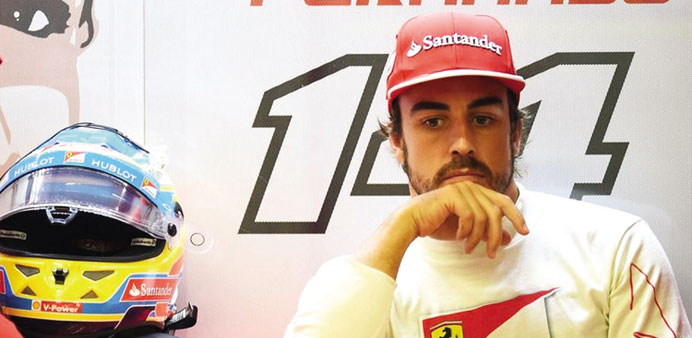
Fernando Alonso