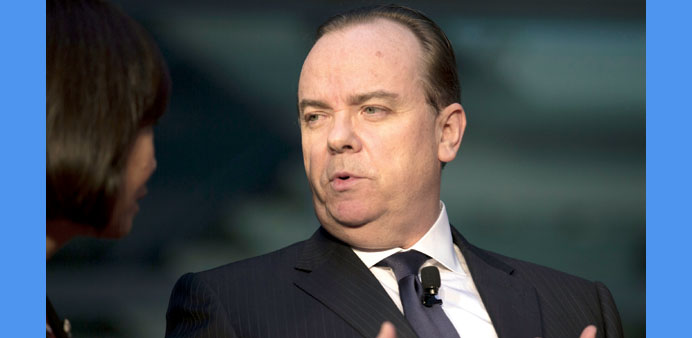
HSBC Holdings CEO Stuart Gulliver gestures as he speaks to Helen Wong, CEO of HSBC Holdings’ Greater China operations, during a ceremony to unveil a commemorative statue at the company’s headquarters in Hong Kong on March 3, 2015. Gulliver, two days before the British election, has criticised British policy makers for driving out global banks with higher taxes and tougher rules.
Bloomberg/London
HSBC Holdings Plc’s chief executive officer Stuart Gulliver, two days before the British election, criticised British policy makers for driving out global banks with higher taxes and tougher rules.
“The UK has rejected the concept of universal banking,” Gulliver told reporters yesterday after the bank posted a 4% rise in first-quarter profit. “We are under significant pressure from our shareholders who don’t understand the extent to which their dividend and the growth of the company is being set back by what they perceive to be is the wrong location.”
HSBC, Europe’s largest bank, is weighing whether to move its headquarters out of the UK, where rising taxes and regulations that will force it to put a firewall around its British consumer bank are eroding profit. Gulliver, 56, is also under pressure to reduce costs, sell assets and improve profitability. He will update investors on his plans on June 9.
“I wouldn’t go by what management has to say on domicile” before elections, said Chirantan Barua, an analyst at Sanford C Bernstein Ltd in London with an outperform on HSBC shares. “Investors will be looking to the bank’s strategy day in June. That’s when the next leg of material news will come.”
HSBC, which generates most of its earnings in Asia, announced last month that it started a formal review of its headquarters after it was hit the hardest by Chancellor of the Exchequer George Osborne’s budget, with tax increases costing banks £5.3bn ($8bn) over the next five years.
Gulliver said that the discussions about a move are “not a threat” to lawmakers.
“It’s a very objective review based on economic arguments around what we need to do to deliver returns to the owners of the company, who are the shareholders,” he said. “The movement in the share prices after the annual general meeting when we said we were going to look at this would tend to indicate that their view is that there are better places to headquarters the holding company.”
The bank fell 1.8% to 634.8 pence at 12:42 pm in London after rising as much as 1.4% in earlier trading. HSBC jumped as much as 3.8% at the AGM on April 24.
HSBC’s review into its domicile will take “months not years” and won’t be completed in time for the strategy day next month, according to Gulliver. Hong Kong is capable of regulating a bank of HSBC’s size and it already oversees most of bank’s profit, the CEO said.
While lawmakers have toughened their rhetoric before elections, British banks have also been faced with increased regulator scrutiny in the wake of the financial crisis. HSBC, which has assets of $2.7bn, is among lenders required to split consumer banking from riskier trading businesses by 2019. To comply with the rules, HSBC is moving some 1,000 jobs from London to Birmingham, England.
HSBC said yesterday first-quarter pretax profit rose to $7.1bn, beating the $5.8bn average estimate of five analysts compiled by Bloomberg. Operating expenses rose 6% to $8.5bn as the bank hired more compliance staff.
Pretax profit in Asia rose 15% to $4.3bn as income rose at a faster pace than costs, according to the statement. Profit in Europe fell 11% to $1.6bn.
The out-performance of Asia “will add to calls for HSBC to re-domicile back to Hong Kong in order to reduce the group’s exposure to lower-performance and higher costs” in the UK and Europe, said Sandy Chen, an analyst at Cenkos Securities Plc with a buy rating on the stock.
The investment bank reported pretax profit of $3.04bn, up from $2.9bn a year earlier. Group provisions for souring loans fell 29% to $570mn.
Unlike Barclays Plc and Royal Bank of Scotland Group Plc, HSBC didn’t need to make further provisions in the quarter to cover the cost of settling probes into the rigging of currency markets. Barclays took a 800mn-pound charge in the first quarter, while RBS set aside £334mn.
HSBC took a $139mn provision at the global private banking division, without giving details. The lender has been embroiled in scandal over allegations its Swiss private bank helped drug cartels and arms dealers launder money, while advising customers on how to evade tax. HSBC also set aside $137mn for a UK customer redress program.
The bank’s tier 1 capital ratio, a measure of financial strength, rose to 11.2% from 11.1%.