


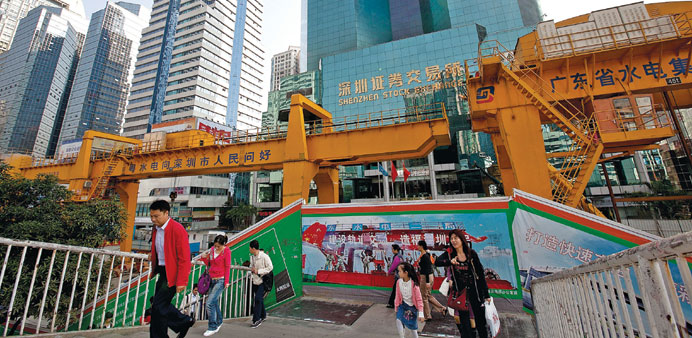
People walk past in front of the Shenzhen Stock Exchange building in China. A boom in China’s stock market this year has delivered limited support to a rapidly cooling economy, helping cash-starved small firms raise funds but failing to boost consumption.
Reuters/Shanghai
A boom in China’s stock market this year has delivered limited support to a rapidly cooling economy, helping cash-starved small firms raise funds but failing to boost consumption.
The blue-chip CSI300 index has shot up 30% from January to April in what local analysts call a “crazy bull run”, while equity fund-raising by Chinese firms has jumped 85% from a year earlier in the first quarter, data showed.
But the anticipated spillover effect of rising stocks into the real economy has so far not materialised.
Annual retail sales were up only 10.6% for the quarter, lagging expectations, while consumer inflation was only 1.2% – both metrics showing few signs that the booming market is supporting consumption, analysts say.
“The market’s boom has made corporate fund-raising easier, particularly for small and medium-sized companies,” which are shunned by banks for loans, said Guo Yanling, senior stock analyst at Shanghai Securities.
She added that Chinese investors do not usually take profits until future speculative gains appear unlikely, partly because equity prices are still largely policy-driven.
That means that cash from paper gains is not likely to flow into spenders’ pockets in the early stages of a bull market when the economy needs it the most. The current rally is partly the result of official efforts to talk up market sentiment as China’s economic growth slips to its slowest in six years.
But once the economy stabilises and valuations have been pushed too high, policymakers often step in to cool the markets, effectively creating a bust that can last a few years such as those from 2001 to 2005 and 2010 to 2014.
Market players say that government only focuses on the market when it needs to as in 2005, when Beijing sought to float two-thirds of the market’s non-tradable state shares or in 2008, during the financial crisis.
This protean official stance encourages a momentum-driven investment culture riding on policy announcements rather than fundamentals. “A market in need instead of a market indeed has pushed investors to try their luck on overnight wealth,” said a senior trader at a major Chinese brokerage in Shanghai.
Chinese officials are now emphasising that corporate fund-raising is crucial to a sustained economic recovery.
“Most companies in the real economy have raised funds via the stock market, and that promotes the development of the real economy,” Chinese central bank governor Zhou Xiaochuan told a news conference in March.
The current rally is now repairing the beaten-down values of shares that have been depressed for many years. That means it has not reached the point where valuations defy fundamentals, leaving some leeway for it to continue rising in coming months.
But if such an investment culture does not change, the market may not provide the support Beijng is hoping for.
“A strong stock market may ‘crowd-out’ the positive wealth effect in China,” HSBC economists Ronald Man in Hong Kong and Li Jing in Beijing said in a research report. “Rising stock prices increase expectations of future returns, which induce residents to substitute away from consumption and towards investment, in order to raise their future income.
“But this behaviour also reduces households’ immediate consumption and is prominent in China where investment channels are still limited.”