


Bloomberg
Beijing
China’s central bank has more than enough room to wield its balance sheet to clean up local-government debt that poses a risk to the world’s second-biggest economy.
The following data show the People’s Bank of China’s balance sheet has grown 16% in two years, compared with 96% for the Bank of Japan and 44% for the Federal Reserve. They also show that China’s borrowing costs through local government financing vehicles are almost double that of sovereign bonds. Issuance of such notes slumped 53% in the first quarter, leaving it to state lenders to help an economy growing at the slowest pace in six years. Speculation the PBOC will prop up bonds spurred the biggest slide in money- market rates in 21 months.
Regional authorities will directly sell more than 1.7tn yuan ($274bn) of bonds this year, a four-fold jump from 2014, to help convert their high-cost corporate notes into cheaper and more transparent borrowing. PBoC Governor Zhou Xiaochuan’s two interest-rate cuts since November have so far ignited a stock rally that has dragged money away from an onshore debt market suffering the fallout of its first defaults.
“It’s likely that commercial banks aren’t willing to buy the municipal notes if the coupon rates offered by local governments are too low,” said Shi Lei, Beijing-based head of fixed-income research at Ping An Securities Co, a unit of China’s second-biggest insurer. “If the debt swap size is going to increase, then banks won’t be able to bear the cost. That could trigger intervention by the PBOC.” CHART 1. China is the only major economy where the central bank’s balance sheet is growing slower than gross domestic product, and “acting in a contractionary manner at a time when the economy desperately needs stimulus,” Dariusz Kowalczyk, Hong Kong-based senior economist at Credit Agricole CIB, wrote in an April 27 research note. He predicts the PBoC will buy about 1tn yuan in regional debt over the coming months.
While the Fed and the BoJ directly bought bonds in quantitative easing to bring interest rates down to zero, the PBoC’s actions may simply be to reduce bond yields. The yield on five-year AA rated corporate notes, the most common grade for LGFVs, is at 5.63%, 2.37 percentage points higher than that of sovereign bonds. Expanding the municipal bond market would make debt repayment easier for regional governments.
Although the PBOC has been pushing to increase the role of bond markets, lending continues to be the dominant fundraising channel. Net non-financial corporate note issuance fell to 63.6bn yuan in March, down from a record high of 387bn yuan in March 2013, as defaults increased. That compares with 992bn yuan of local currency loans last month due to a shadow-banking crackdown. The PBOC is considering expanding a lending program to encourage banks to buy local government bonds, according to people familiar with the matter.
Lenders would be able to use municipal bonds as collateral.
The one-month Shanghai Interbank Offered Rate declined 140 basis points in April, the most since July 2013. The yield on one-year AAA corporate bonds has dropped 75 basis points, the most since 2008, amid speculation of PBoC support.
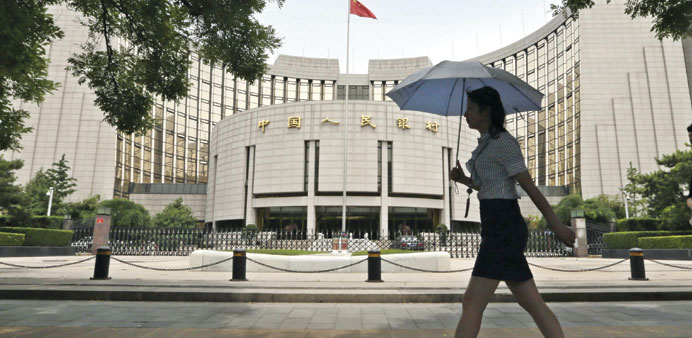
A pedestrian walks past the People’s Bank of China headquarters in Beijing. Although the PBoC has been pushing to increase the role of bond markets,