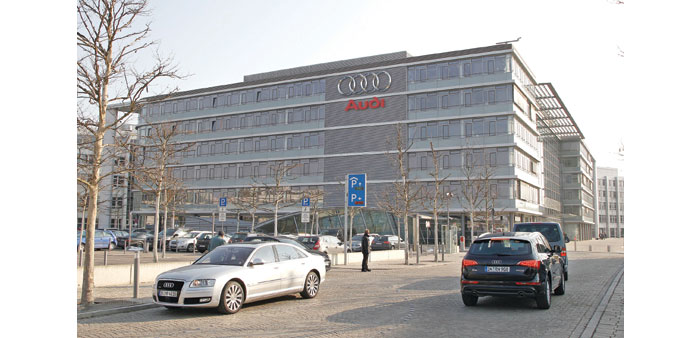
Audi’s race to catch up with German rival BMW is taking its toll on its profit margin, although the car maker delivered higher underlying earnings on sales of its luxury saloons and sport-utility vehicles.
Audi, the profit engine of Europe’s largest automaker Volkswagen, said yesterday first-quarter operating profit rose 8.2% to €1.42bn ($1.58bn), fuelled by growing demand for the A6 saloon and Q3 sport-utility vehicle.
But persistent spending on models, technology and foreign expansion is squeezing margins at a time when premium car makers are fighting to attract buyers amid slowing demand in emerging markets.
Audi’s operating margin slipped to 9.7% from 10.1% a year earlier, the car maker said, reaffirming its 8-10% target range.
“Despite ongoing high investment, we are systematically pursuing our ambitious profitability targets,” finance chief Axel Strotbek said in an emailed statement. The Ingolstadt, Germany-based brand, which eclipsed rival Mercedes-Benz in 2011 as the world’s second-largest maker of luxury cars by sales, plans to expand its lineup to 60 models by 2020 from 52 now, and is investing more than €1bn ($1.11bn) in new factories in Mexico and Brazil.
Audi stuck to its guidance for higher revenue and a “significant” gain in auto sales this year despite challenging developments in world economies and foreign exchange markets.
Audi’s parent VW posted higher-than-expected earnings on cost reductions and Europe’s strengthening auto recovery.
Comcast
Comcast Corp, the largest US cable operator, posted better-than-expected first-quarter profit, driven by strong growth in its high-speed Internet and business services. Comcast, which increased its stock buyback program to $10bn last quarter, said it would now earmark $6.75bn for 2015, higher than the $4.25bn it had previously set aside for the year.
Comcast, which abandoned its proposed $45bn merger with Time Warner Cable Inc in late April, said yesterday its total revenue rose 2.6% to $17.9bn in the quarter ended March 31.
Net income attributable to Comcast rose 10% to $2.1bn, or 81 cents per share, from a year earlier.
Profit was 79¢ per share after excluding items such as investments and acquisition-related items. This beat analysts’ estimates of 74¢ per share, according to Thomson Reuters I/B/E/S.
The company, which added video customers last quarter, said it lost 8,000 subscribers from January through March, compared to the 24,000 additions a year earlier.
Wall Street keeps a close watch on the number of new video subscribers as pay TV operators fight to keep customers amidst intense competition from streaming video services.
The number of Comcast’s high-speed internet customers rose by 6.2% to 407,000. Revenue from that business was up about 11%, the highest growth rate in four years, to $3.04bn.
Business services revenue was up 21.4% to $1.11bn.
Luxottica
Italian eyewear group Luxottica posted a higher-than-expected 33% rise in operating profit in the first quarter, which marked the debut of its two newly-appointed chief executives.
Earnings before interest and tax (EBIT) at the maker of Ray Ban sunglasses came in at €358mn ($399mn), topping a consensus forecast of €348mn thanks to efforts to keep a lid on cost rises.
Revenues were broadly in line with analyst estimates at €2.2bn, rising 5% at constant currencies.
Luxottica stuck with its full-year forecast of a mid-to-high single digit increase in 2015 revenues, and predicted that operating and net profits would rise twice as fast as that.
First-quarter sales rose 20% when including the impact of a stronger dollar on Luxottica’s US revenues, which account for more than half of the total.
The successful launch of Michael Kors glasses and recovering sales at optical chain LensCrafters helped the US market, where Luxottica launched a reorganisation of Oakley, the California-based sports eyewear brand acquired in 2007.
The flip side of a weaker euro was that it increased the cost of Luxottica’s production in China, which represents 42% of the total, and the US, accounting for another 10%. Vian said, however, that the group managed to cut manufacturing and logistics costs by 3% at constant currencies.
The optical retail business in Australia was the only weak spot in the quarter, but that was offset by higher sales of sunglasses, he said. Good weather compared to last year also helped push European revenues.
Westpac
Shares in Australian banking heavyweight Westpac slumped yesterday after a worse than expected first-half net profit of A$3.61bn ($2.82bn), with solid mortgage lending growth offset by its institutional arm taking a hit.
The cash profit of Australia’s second largest bank, the industry’s preferred measure which strips out volatile items, was A$3.77bn in the six months to the end of March.
Both sets of numbers were similar to the previous year, with the lack of profit growth sending the stock down as much as 4.9% before it recovered to end the day 3.08% lower at A$35.60.
The soft data reverberated onto Australia’s other major banks, which all lost ground. ANZ Bank ended down 2.67%, National Australia Bank was off 1.41% and the nation’s biggest company, Commonwealth Bank, fell 1.02%.
Despite the flat result, Sydney-based Westpac lifted its interim dividend to 93¢ per share.
Westpac is the first of the big Australian lenders to release half-year earnings, with ANZ reporting Tuesday and National Australia Bank on Thursday.
Westpac chief executive Brian Hartzer, who took over from Gail Kelly in February, said Westpac’s retail and business banking divisions performed well.
“However, the headline result was impacted by derivative adjustments in our Westpac Institutional Bank business and a lower treasury result,” he said.
Cash earnings in the institutional arm were down 17%, largely due to an Aus$85mn charge relating to derivative valuations.
“Our primary goal is to continue to build the value of our franchise, and the drivers of value are heading in the right direction,” he added.
Hartzer said the bank continued to grow its customer base while also delivering Aus$230mn in efficiency gains and reducing stressed assets.
“In our retail and business banking divisions we had solid loan and deposit growth, along with well managed margins,” he said.
Westpac said its housing loans in Australia were up 7% while personal lending jumped 8% and business lending grew 5%.
Loews
Loews Corp reported a lower-than-expected quarterly profit as its energy subsidiary reported a loss and revenue fell at its insurance unit.
The conglomerate’s income from continuing operations fell 59% to $109mn, or 29¢ per share, in the first quarter ended March 31 from a year earlier.
According to Thomson Reuters I/B/E/S, Loews earned 69¢ per share on an adjusted basis, below the average analyst estimate of 75¢.
Loews, controlled by New York’s Tisch family, said total revenue fell 5.7% to $3.48bn.
Diamond Offshore Drilling Inc, Loews’ second-biggest subsidiary, reported a net loss, compared with a year-ago profit, mainly due to an impairment charge of $319mn as it wrote down the value of eight rigs.
Oil producers, slammed by a slump in crude oil prices since June, are renegotiating or cancelling contracts, piling pressure on contract drilling companies.
Diamond Offshore suspended its special dividend in the first quarter. Loews has turned to its property and casualty insurance subsidiary, CNA Financial Corp, to generate most of its dividend.
CNA, Loews’ largest subsidiary, yesterday maintained its quarterly dividend of 25¢ per share.
CNA’s net operating income rose 18.4% to $225mn from a year earlier, helped by higher investment income and lower catastrophe losses.
CNA earned 83¢ per share, 2¢ above the average analyst estimate.
CNA’s quarterly combined ratio improved to 98.9% from 101.6% last year. A combined ratio of over 100 indicates that an insurer has an underwriting loss.
Loews has over the years trimmed CNA’s operations, hiving off its life insurance, personal automobile insurance, health insurance, reinsurance, and annuity and pension deposit businesses.
Loews completed the sale of its natural gas subsidiary, HighMount Exploration & Production LLC, in October due to low natural gas prices caused by a shale boom. Loews also owns Boardwalk Pipeline Partners LP and Loews Hotels & Resorts.
GrubHub
GrubHub Inc reported a 50.6% rise in quarterly revenue and the online food order company spent heavily to build its food-delivery network.
The company, which started delivering food directly to diners with the acquisition of DiningIn and Restaurants on the Run, said total costs and expenses jumped 38.5% to $69.8mn in the first quarter ended March 31.
The company has aggressively bought smaller rivals over the last few years. It bought Seamless last year, to boost its presence in the US East Coast. Seamless is popular with large businesses, which order food for employees working long hours.
The company, which delivers everything from expensive steaks to bento boxes, receives a commission from restaurants on orders booked through its website and its mobile application.
GrubHub said it expects revenue of $83.5mn-$85.5mn for the second quarter.
Analysts on average were expecting $83.7mn, according to Thomson Reuters I/B/E/S.
First-quarter revenue increased to $88.2mn from $58.6mn. The number of active diners using GrubHub’s services jumped about 46% to 5.6mn.
Net income attributable to common shareholders rose to $10.6mn, or 12 cents per share, from $4.4mn, or 6 cents per share, a year earlier.
Diamond Offshore
Diamond Offshore Drilling Inc, one of the world’s top five offshore rig contractors, said it was scrapping three rigs in the face of weak demand due to a steep fall in global crude prices.
The company said yesterday it recorded an impairment charge of $319mn for eight rigs, including the rigs being retired, in its first-quarter results.
The charge caused the company to report a quarterly loss for the first time since June 2004.
Diamond Offshore, which has 33 rigs, said last year it would idle or sell eight rigs.
Excluding the write-down and a $4mn charge for restructuring and severance costs, the company posted an adjusted profit of 50¢ per share, according to Thomson Reuters I/B/E/S. Analysts on average had expected 43¢.
A number of oilfield companies are cutting jobs and retiring rigs in response to weakened demand from oil producers, who are scaling back spending to cope with a 43% decline in global crude prices since June.
Utilization rates for Diamond Offshore’s ultra-deepwater rigs, its biggest business, fell to 51% in the quarter ended March 31, from 66%, a year earlier.
Net loss was $255.7mn, or $1.86 per share, in the first quarter, compared with a profit of $145.8mn, or $1.05 per share, a year earlier.
The Houston-based company’s total revenue fell 12.6% to $620mn.
Up to Friday’s close of $33.47, the stock had declined nearly 9% this year.