


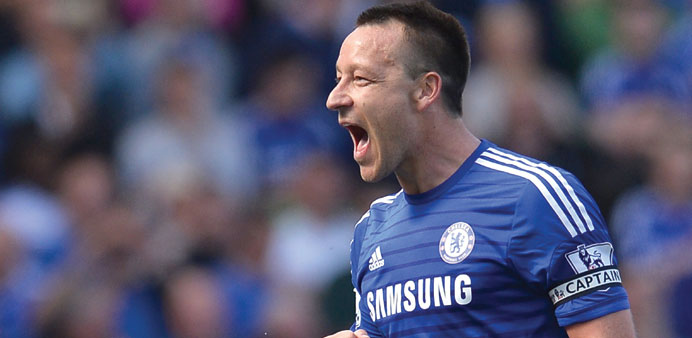
Chelsea’s English defender John Terry celebrates after the English Premier League football match between Chelsea and Crystal Palace at Stamford Bridge.
By Barney Ronay, The Guardian/London
As the final whistle was blown on Chelsea’s title-clinching defeat of Crystal Palace there were the usual well-groomed home-ground eruptions of joy from players and staff. José Mourinho hugged his family. The kit-man made an ill-advised attempt to hoist the physio on his shoulders. A bobbing huddle formed in front of the Matthew Harding stand. And most striking of all was the sight of John Terry, away from the singing and the waving scarves, down on his knees, eyes closed, lost in a moment of startlingly intense communion with the Stamford Bridge turf.
If there was a degree of rawness to Terry’s private celebrations, a refusal to be glazed by repetition, then this is testimony in itself to the winning qualities of Chelsea’s captain. When it comes to Terry and Chelsea in the modern era one thing is certain: he is entirely synonymous with success, a one-man raven in the tower whose eventual departure, most likely at the end of his new one-year contract, will require a complete making-over of what a Chelsea Premier League title triumph is supposed to look like.
There is a remarkable personal statistic lurking in here. Chelsea Football Club has now won 25 major honours. Terry has been present for 16 of these, or 64% of the club’s total accumulated silverware since it was called into existence in 1905 to fill an empty stadium originally intended for Fulham.
If Terry’s trophy ratio is skewed by the clumping together of so much success in the billionaire-ball present, then his ability to stay the course is an achievement in its own right. Ten years on from his first league title Chelsea’s captain has seen seven managers come and go, not to mention at least 20 semi-regular central defensive partners and the relentless ups and downs and ins and outs of an occasionally hair-curling public-private life.
And yet here he is. Still captaining, still leading, still legending. For a man who seems to have been playing through near-terminal injury for much of the last decade there is a remarkably consistent pitch to Terry’s sustained defensive presence. Not to mention a fair case to be remembered as among the most enduring of England’s overheated Baden-Baden generation, a player who really did leave nothing – aside from some rancour and the odd piece of cartilage – behind on the pitch.
Graeme Le Saux was a senior player when Terry was first making the leap from youth to first team. “When you see someone develop from 16 and then you see what they’ve achieved you sometimes can’t quite believe it’s the same person,” he says now. “He was very confident when he first came over to join training with the first-team players. He wasn’t the biggest or the quickest but I remember noticing immediately that he read the game very well. He had an inquisitive mind and he would always be asking questions.”
Seventeen years down the line there is even a kind of mawkishness in Terry’s supreme devotion to his adopted west London home, not to mention his fabled indestructibility. It did not make many headlines but one of Terry’s defining performances this season came at West Ham last month three days after the Capital One Cup final. Holding his back, flexing a hamstring, booked for one desperate rugby-style assault on Enner Valencia,
Terry gave a horrible but also oddly unbreachable performance as Chelsea won 1-0 and the cruise towards the title was bundled back on track.
“He’s got up off the medical table to play games when he shouldn’t have, he’s so committed to playing even against medical advice,” Le Saux says. “You think of the wear and tear on his body, the psychological baggage he’s had to carry, the good and the bad: recovering from the penalty miss in the Champions League final in Moscow, the fact he had the breakdown with England and what a massive loss not playing is for him personally. He’s had to deal with a lot, some of it self-inflicted to be fair”.
At this stage there isn’t a great deal left to say about Terry’s off-field adventures. This a player whose professional life has been measured out in unsavoury newspaper splurges, overshadowed for many by the criminal charge of racially abusing a fellow professional, with its courtroom “sarcasm” defence. Terry denied the charge and was found not guilty.
Suffice to say Terry will never be loved by many outside Stamford Bridge, and with good reason perhaps. And yet in pure footballing terms it has been a little too easy for some to dismiss Chelsea’s captain as a bone-headed trier, a luddite with an armband. The fact is Terry has always been a skilful, very modern kind of central defender, a player who is perhaps appreciated more outside his home country.