


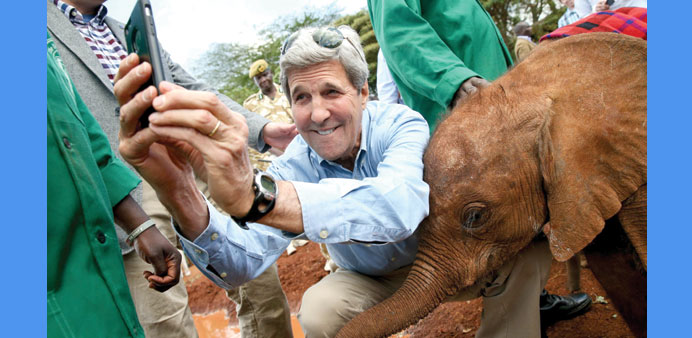
US Secretary of State John Kerry takes a selfie with a baby elephant while touring the Sheldrick Centre Elephant Orphanage at the Nairobi National Park. The centre’s Orphans’ Project hand rears elephant and rhino orphans in a rehabilitation program to help protect Kenya’s threatened animal populations struggling against poaching and loss of habitat.
AFP/Nairobi
US Secretary of State John Kerry yesterday vowed support to Kenya in the battle against Somalia’s Al Qaeda-affiliated Shebaab, after calling for unity in the face of terror attacks.
“The US continues to stand resolutely with the government and people of Kenya in the effort to end scourge of violent extremism,” Kerry said in a message on Twitter.
Kenya is struggling to stop increased cross-border attacks by the militants even though it has thousands of troops in neighbouring southern Somalia as part of an African Union force, which Washington has funded by over half a billion dollars since 2007.
Kerry’s trip to the east African nation is the first high-level visit since 2012, and comes after years of tensions surrounding Kenyan President Uhuru Kenyatta after he was charged by the International Criminal Court for crimes against humanity.
The ICC has since abandoned the case against Kenyatta over his alleged role in the 2007-2008 post-election violence, citing a lack of evidence and Kenya’s failure to cooperate - somewhat removing Kenyatta’s pariah status.
Kenyatta told Kerry during their meeting that the country needs “support in terms of training, equipment and surveillance,” as well as to “work more closely with the US to control financing of terrorism,” a Kenyan government statement read.
Few other details of the meeting were given, but diplomats earlier said Kerry would raise human rights issues with Kenyatta, whose government has been accused of clamping down on civil society groups and the press.
The pair’s meeting also came as Kenya’s deputy president William Ruto reportedly told worshippers at a church service in Nairobi that homosexuality “violates our religious and cultural beliefs.”
Kerry and Kenyatta met for around half an hour, with the secretary of state saying it was a “good meeting”. The US envoy also met opposition leaders.
Kerry’s trip also comes ahead of US President Barack Obama’s visit to his late father’s home country in July.
Earlier, Kerry visited a memorial in Kenya to the 1998 bombing of the US embassy. The attack by Al Qaeda was the worst carried out by Islamist militants against the east African nation, killing 213 people.
“The terrorists who struck on August 7, 1998, failed utterly in their purpose, which was to implant fear in the hearts of the Kenyan people and to divide America from the citizens of this country,” Kerry said.
“They failed for the same reason that terrorists will always fail. Yes they can reduce a building to rubble, and yes they can even deprive innocent people of their lives, but they do not give anyone anything of what really makes life worthwhile.”
Last month Shebaab gunmen massacred close to 150 people, mostly students, in a raid on a university in the northeastern Kenyan town of Garissa.
The raid followed a string of other massacres in the northeast and Muslim-majority coastal areas, and after the September 2013 siege of the Westgate shopping mall in Nairobi which left at least 67 dead.
“We do have however the power to fight back, not only with our military and law enforcement, but also through something that may be even more powerful and that may make a bigger difference in the end, and that is our unity and the character of our ideals,” Kerry said.
Kerry, who arrived from Sri Lanka on Sunday afternoon, later heads for the Horn of Africa nation of Djibouti, where the US has a major military base, and where refugees from war-torn Yemen are arriving.
Kerry then heads to Saudi Arabia and France for talks on regional security, as well as to take part in commemorations marking the end of World War II in Europe.