


Bloomberg/Stockholm
Sweden will look at imposing a financial activity tax on its banks as the new Social Democratic government seeks revenue to push down Scandinavia’s highest unemployment.
The plan was revealed on Friday by Finance Minister Magdalena Andersson in a May 1 speech in Stockholm. The government will start an evaluation next week on a financial activity tax, rather than a transaction tax, she said.
“If you look at the Swedish financial sector it is today under-taxed,” she said. “They are not paying any VAT and when we look in the newspapers we’re seeing that the four largest banks are making big money.”
Andersson, whose minority government took over last year, has pledged to cut unemployment down to the lowest in the European Union over the next five years. Yet she’s running up against budget limits, with deficits forecast through 2017.
Sweden’s biggest banks include Nordea Bank, SEB, Svenska Handelsbanken and Swedbank.
“The Social Democrats want to make sure that the responsibility for financing both welfare and investments are distributed as fairly as possible,” Andersson said.
The government hopes to be able to introduce an activity tax at some point during this term, which ends in 2018.
The finance minister has also proposed looking into scrapping the nation’s 1% surplus target for a balanced budget approach to free up money for investments.
On top of that, it’s considering carving out a separate investment plan as it raises spending on infrastructure and housing to create jobs, Prime Minister Stefan Loefven said last month.
Sweden’s seasonally-adjusted unemployment rate was 7.7% in March, compared with 4.7% for Germany, according to Eurostat.
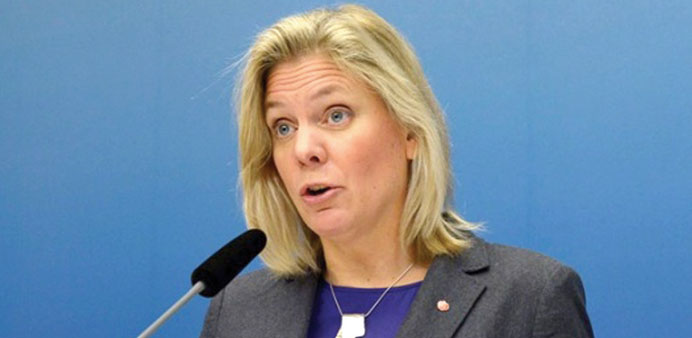
Andersson: Bold steps.