


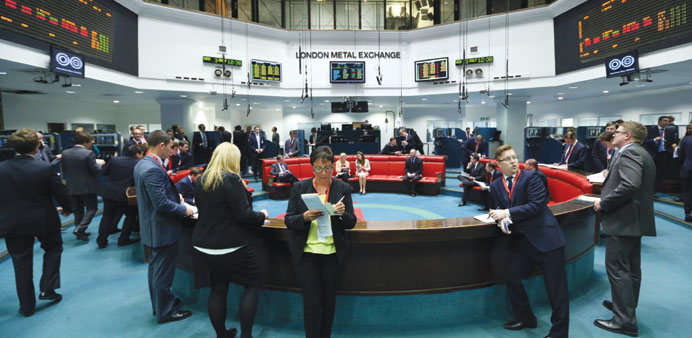
Traders stand outside the open outcry pit at the London Metal Exchange. The LME has fined one of its warehousing operators, CWT Commodities (Metals), £100,000 for breaching information barriers with associated trading firms.
By Andy Home/London
The London Metal Exchange (LME) has fined one of its warehousing operators, CWT Commodities (Metals), £100,000 ($149,000) for breaching information barriers with associated trading companies.
At a time when multi-million dollar penalties are regularly being levied against the banking sector for a litany of past bad behaviour, 100,000 pounds may sound like peanuts. But it’s actually the second-highest fine imposed by the LME on any of its warehousing companies.
The dubious distinction of highest-ever fine goes to Albatros, which got hit with a 200,000-pound charge in the late 1990s for storing tin that didn’t meet contract specifications.
The result was the forced cancellation of 1,000 tonnes of metal with what the LME termed “substantial disruption in the market” and a protracted court battle between the LME and Albatros.
The only directly comparable disciplinary action to that against CWT was the 50,000-pound fine imposed on Henry Bath in 1999 for trading metal on its own account. CWT does not appear to have been guilty of such a flagrant disregard for LME rules but can’t be surprised it has been hit so hard given the current regulatory scrutiny of all things related to LME warehousing.
And information barriers cut to the heart of one of the most contentious areas of LME storage, namely the ownership of many warehousing operators by trading companies.
Actually, CWT isn’t owned by a metals trading company. Rather, it owns one in the form of MRI Group, a specialist raw materials trader that absorbed another group trading entity, LN Metals, a year or so ago. And at least two others, it seems, since the accusation is that CWT “failed to identify two companies within its corporate group which were Trading Companies (...) despite repeated requests from the LME to do so”.
From that failure flows a long list of charges dating to 2012 about persistently not complying with the LME’s information barrier rules, intended to prevent trading companies benefiting unfairly from their relationship with warehouse operators.
But this is hardly the stuff of grand conspiracy. After all, the LME conceded that it had found no evidence that CWT deliberately broke the rules, that any sensitive information had actually been exchanged or that any third party was affected.
CWT’s real offence seems to have been failing to ask its parent for a proper organisational chart, given “its own policies and procedures failed to identify the fact that the two entities were trading companies” as defined by the LME rulebook.
Perhaps that’s understandable given the complexity of the CWT group, with 6,000 employees engaged in all aspects of the logistics business from wine storage to defence contracts as well as in financial services and asset management.
Ignorance is, however, no defence, least of all when the LME has the UK regulator, the Financial Conduct Authority, breathing down its neck after a string of allegations about the impact of its warehousing system on the aluminium market.
Moreover, LME rules place the onus on complying with its information rules on the warehouse operators rather than any related non-member trading entities, over which it has by definition no jurisdiction.
In other words, if CWT didn’t know, it should have known and it, not the parent group or those two mysterious trading entities, must bear the consequences.
That said, there is a sense that the LME has swatted a fly with its action against CWT, to borrow the language used by the Chinese leadership in its anti-corruption drive. CWT is certainly no LME warehousing tiger.
Its sheds held 44,857 tonnes of registered metal at the end of March, accounting for just 0.81% of LME stocks.
It is one of several minnows operating in a sector dominated by four tigers. Between them Pacorini, Steinweg, Metro and Henry Bath held over 95% of registered LME tonnage at the end of March. Pacorini is the dominant tiger, storing more than half of all exchange-registered stocks in its system. This is not entirely surprising given it is owned by Glencore, the powerhouse of physical metals trading.
Henry Bath is now owned by trading house Mercuria, having been sold by JPMorgan. Metro was owned by Goldman Sachs, a relationship that provoked much of the original outcry over LME warehousing. It is now owned by the Reuben brothers, who have a long history of active metals trading.
Steinweg is the only independent, a statement that holds truer since the apparent cutting of ties, always obscure, with Asian metals trader Raffemet.
There’s been no suggestion of impropriety against such tigers but linear hierarchical links between trading and LME logistics are by their nature problematic.
Particularly when two of those operators, Pacorini and Metro, are the owners of two long load-out queues at Vlissingen and Detroit respectively.
Consider, for example, a US Senate subcommittee’s findings on the relationship between Goldman and Metro, as part of a broader hearing on Wall Street banks’ involvement with physical commodities.