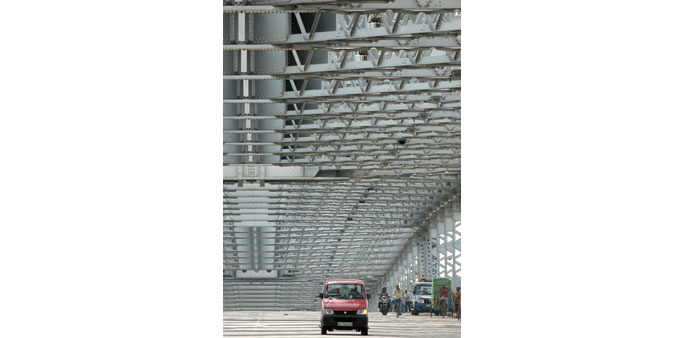
Commuters travel across the deserted Howrah bridge during a general strike in Kolkata yesterday. Life in West Bengal was thrown out of gear by a state-wide dawn-to-dusk general strike and shutdown called by the Left Front and the Bharatiya Janata Party (BJP) and a nationwide transport strike by trade unions.
IANS/Kolkata/New Delhi/Chandigarh/Thiruvananthapuram
Millions of commuters across India were left stranded yesterday as buses and taxis did not ply to protest against a proposed law that makes punishment for traffic violations more stringent.
Passengers had to wait endlessly at railway stations in various cities as public transport went off the road. People were forced to trudge with heavy luggage and office-goers too were hit hard.
The strike was part of a nationwide protest by major trade unions demanding the repeal of the Road Transport and Safety Bill, 2014, and alleged anti-worker policies of the Bharatiya Janata Party (BJP)-led central government.
The protest is against the hefty penalties that are proposed in the new bill such as Rs50,000 for rash driving, Rs10,000 for drunken driving and up to Rs6,000 for speeding. The bill is to be put before the cabinet for approval.
The bill also proposes a regulatory authority which would advise the central and state governments on road safety, and also have the powers to ensure that the norms laid down are followed by all stakeholders.
Transporters say the penalties, along with the proposed norms on testing of vehicles, road-worthiness, licensing, among others, are too stringent.
The ministry of road transport and highways, however, says this is necessary to reduce road accidents by at least 200,000 over the next five years, as opposed to some 490,000 accidents each year - 25% of them fatal in nature.
The protest had a partial impact in Delhi, where a few auto-rickshaws and taxis were on the roads. There were a few buses too running but all were crowded.
An office-goer in south Delhi said he saw just one Delhi Transport Corporation bus and no private buses for over an hour.
State roadways, private buses and taxis did not ply across Haryana, causing misery to thousands of passengers. Buses remained parked at bus depots, and passengers were left stranded.
Auto-rickshaws and cycle-rickshaws overcharged people wanting to reach their destination on time.
Life in West Bengal was thrown out of gear by a dawn-to-dusk shutdown. Most of the roads across the state, including in the capital Kolkata, wore a near-deserted look.
Passengers at the busy Howrah and Sealdah railway stations and office-goers had a difficult time as there were no taxis or buses. There were reports of buses being vandalised in several parts of Kolkata and Howrah.
While most of the private schools remained closed, attendance at government schools was negligible.
“After struggling to get a conveyance to reach my child to school, I found it nearly empty. Most of the students and teachers and even the principal is absent. I do not support such kind of politics of disruption,” said a parent.
Activists of the Communist Party of India (Marxist), which leads the opposition Left Front in west Bengal, took out rallies in many parts of the state in support of the strike.
Life in Left Front-ruled Tripura was affected as all means of public transport stayed off the roads.
Commuters, office-goers and passengers faced inconvenience as buses, small and medium vehicles, auto-rickshaws and even battery-operated rickshaws remained off the roads.
“The strike was spontaneous and total. No untoward incident was reported from anywhere in the state,” Centre of Indian Trade Unions (CITU) leader Tapas Datta said in Agartala.
Transport workers yesterday also organised protest rallies across Tripura to denounce the proposed bill.
In Himachal Pradesh, employees of the state-run Himachal Road Transport Corporation (HRTC), which has a fleet of over 2,200 buses, were on strike.
The strike hit commuters hard with connectivity between cities and towns affected. However, several private buses were on the road.
The strike also had an effect in Kerala, with hundreds of people who arrived at various bus stands, railway stations and airports getting stranded.
In Telangana and Andhra Pradesh, the protest evoked partial response.
Transport services were partially affected in Hyderabad as a section of auto-rickshaws, taxis and trucks remained off the roads.
With major employees’ unions in state-owned Road Transport Corporation (RTC) not participating in the protest, the public transport was not impacted in the two Telugu-speaking states.
Some unions of auto drivers organised a rally in Hyderabad to protest against what they called anti-workers measures proposed in the central bill.
The nationwide strike had no impact in Tamil Nadu.
State-owned buses plied as usual while some privately-owned buses and auto-rickshaws stayed away from the roads.