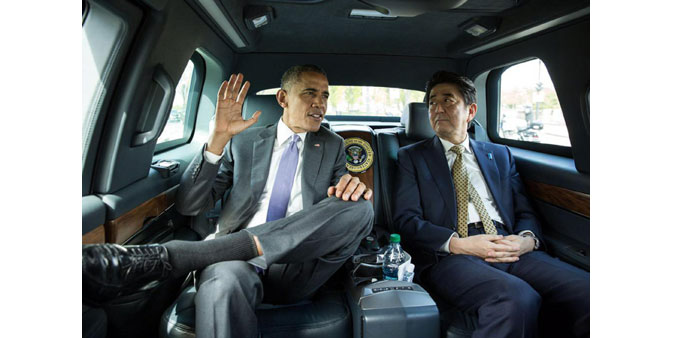
President Obama with prime minister Shinzo Abe en route to the Lincoln Memorial in Washington.
AFP/Tokyo
The United States and Japan sought to reinvigorate their 70-year alliance in the face of China’s growing clout yesterday, with president Barack Obama welcoming prime minister Shinzo Abe to the White House.
Voicing shared anxiety about China’s activities in the South and East China Seas, the two leaders vowed to counter new threats and increase joint military deterrence.
Obama accused China of “flexing their muscles” though territorial claims and the building of new islands in disputed waters.
“There are some real tensions that have arisen with China around its approach to maritime issues and its claims,” Obama said.
The US president reiterated his “absolute” commitment to Japan’s defence and stressed that pledge “covers all territories under Japan’s administration, including Senkaku Islands”.
Beijing lays claim to the island chain it calls the Diaoyu.
Now for the first time that US defense assurance will be reciprocated, thanks to a deal signed during Abe’s visit.
Japan’s well-trained and well-equipped forces will be able to come to the defence of the United States, a dramatically more assertive security role for the officially long-pacifist country.
But, Obama insisted, “we don’t think that a strong US-Japan alliance should be seen as a provocation”.
“We welcome China’s peaceful rise.”
Abe and Obama also pledged to forge ahead with a Trans-Pacific trade deal that would encompass 12 countries and 40% of the world economy, but which does not include Beijing.
China has increasingly been making its economic prowess felt, pushing hard for the creation of an Asian Infrastructure Investment Bank to rival US-backed institutions.
Obama denied that the United States opposed the bank, but said transparency was essential.
“What we don’t want to do is just be participating in something and providing cover for an institution that does not end up doing right by its people,” he said.
Abe will today become the first Japanese prime minister to address a joint session of the US Congress.
Congress is currently weighing whether to give Obama the means to reach a trade deal with Japan and 10 other nations in the Pacific.
A tight vote is expected.
During the White House visit, Obama held Oval Office talks with Abe.
On Monday, Obama took Abe on an unannounced tour of the Lincoln Memorial, riding together in Obama’s armored limousine -- “the beast” -- to underscore their personal ties.
“Walking together with you at the Lincoln Memorial, which has witnessed America tread the path of democracy, will be an extraordinary memory to be cherished,” Abe said.
“Today the international order faces fresh challenges, ranging from violent extremism to cyber attacks,” a joint statement said.
“State actions undermine respect for sovereignty and territorial integrity by attempting to unilaterally change the status quo by force or coercion pose challenges to the international order,” the text said.
“Such threats put at risk much that we have built. We must and will adapt again, working in concert with other allies and partners.”The United States and Japan agreed to a new set of defence cooperation guidelines that would “reinforce deterrence” by allowing Japanese forces to come to the aid of US forces and “enable Japan to expand its contributions to regional and global security”.
It is a significant step for two countries that had been locked in a brutal war that ended with the first and only use of atomic bombs in combat history.
“If we don’t write the rules, China will write the rules out in that region,” Obama told the Wall Street Journal ahead of the meeting.
Even if progress is made, Obama has faced critics within his own party who believe the deal would allow American jobs to be shipped overseas.
Obama said the idea that he was “trying to just destroy the middle class or destroy our democracy is a little unrealistic. And they know it.”
Trade negotiators are still working on tough issues linked to automobiles and agriculture. But with Obama looking for a bipartisan trade victory and Abe keen to bolster his domestic economic reforms, an eventual deal seems likely.
Obama warned yesterday that the China-led Asian Infrastructure Investment Bank (AIIB) needs strong rules for governance and transparency to ensure projects benefit the people who live near them.
Obama said he was not opposed in principle to the bank, which most US allies have joined, but said the institution risked funding projects where money was misused unless there were guidelines like those used by the World Bank and International Monetary Fund.
“When these countries borrow money, even from a development bank, for a boondoggle project that doesn’t work, they’re often times still on the hook for paying that money back,” Obama told reporters at a news conference with Japanese prime minister Shinzo Abe.
Without strong rules, the bank could fund projects that “may be very good for the leaders of some countries and contractors, but may not be good for the actual people who live there”, Obama said.
He said he wanted to “dispel” reports the United States tried to convince its allies to stay out of the bank.
“That is simply not true. It sprung up out of one story after the Brits decided that they were going to join up and then folks have just been running with it,” Obama said, adding he was “all for” the AIIB, if the bank was well run.
Abe also spoke about the need for “fair governance” of the AIIB, but emphasiaed he saw “eye to eye” with China on the need for financing of infrastructure in Asia.
“For Japan to participate in the AIIB is a decision that we have not taken yet,” Abe said.