


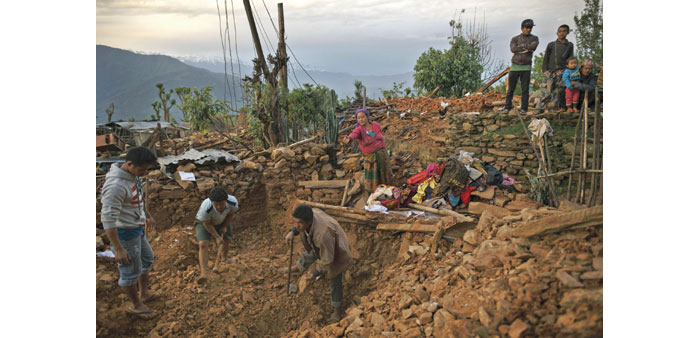
Local villagers try to salvage their belongings from the debris of their house at a devastated area following Saturday’s earthquake at Paslang village in Gorkha district of Nepal yesterday.
Reuters
Jharibar/Sindhupalchowk
People stranded in remote villages and towns across Nepal were still waiting for aid and relief to arrive yesterday, four days after a devastating earthquake destroyed buildings and roads and killed more than 4,600 people.
The government has yet to assess the full scale of the damage wrought by Saturday’s 7.9 magnitude quake, unable to reach many mountainous areas despite aid supplies and personnel pouring in from around the world.
Prime Minister Sushil Koirala said the death toll could reach 10,000, as information of damage from far-flung villages and towns has yet to come in.
That would surpass the 8,500 who died in a 1934 earthquake, the last disaster on this scale to hit the Himalayan nation.
“The government is doing all it can for rescue and relief on a war footing,” Koirala said. “It is a challenge and a very difficult hour for Nepal.”
In Jharibar, a village in the hilly Gorkha district close to the quake’s epicentre, Sunthalia dug for hours in the rubble of her collapsed home on Saturday to recover the bodies of two of her children, a 10-year-old daughter
and eight-year-old son.
Another son aged four miraculously survived.
In Barpak, further north, rescue helicopters were unable to find a place to land. Yesterday, soldiers had started to make their way overland, first by bus, then by foot.
Army helicopters also circled over Laprak, another village in the district best known as the home of Gurkha soldiers.
A local health official estimated that 1,600 of the 1,700 houses there had been razed. Helicopters dropped food packets in the hope that survivors could gather them up.
In Sindhupalchowk, about 3.5 hours by road northeast of Kathmandu, the earthquake was followed by landslides, killing 1,182 people and seriously injuring 376. A local official said he feared many more were trapped and more aid was needed.
“There are hundreds of houses where our people have not been able to reach yet,” said Krishna Pokharel, the district administrator. “There is a shortage of fuel, the weather is bad and there is not enough help coming in from Kathmandu.”
International aid has begun arriving in Nepal, but disbursement has been slow, partly because aftershocks have sporadically closed the airport.
According to the home (interior) ministry, the confirmed death toll stands at 4,682, with more than 9,240 injured.
The United Nations said 8mn people were affected by the quake and that 1.4mn people were in need of food.
Nepal’s most deadly quake in 81 years also triggered a huge avalanche on Mount Everest that killed at least 18 climbers and guides, including four foreigners, the worst single disaster on the world’s highest peak.
All the climbers who had been stranded at camps high up on Everest had been flown by helicopters to safety, mountaineers reported on Tuesday.
Up to 250 people were missing after an avalanche hit a village yesterday in Rasuwa district, a popular trekking area to the north of Kathmandu, district governor Uddhav Bhattarai said.
A series of aftershocks, severe damage from the quake, creaking infrastructure and a lack of funds have complicated rescue efforts in the poor country of 28mn people sandwiched between India and China.
In Kathmandu, youths and relatives of victims were digging into the ruins of destroyed
buildings and landmarks.
“Waiting for help is more torturous than doing this ourselves,” said Pradip Subba, searching for the bodies of his brother and sister-in-law in the debris of Kathmandu’s historic Dharahara tower.
The 19th century tower collapsed on Saturday as weekend sightseers clambered up its spiral stairs. Scores of people were killed when it crumpled.
Elsewhere in the capital’s ancient Durbar Square, groups of young men cleared rubble from around an ancient temple, using pickaxes, shovels and their hands. Several policemen stood by, watching.
Heavy rain late yesterday slowed the rescue work.
In the capital, as elsewhere, thousands have been sleeping on pavements, roads and in parks, many under makeshift tents.
Hospitals are full to overflowing, while water, food and power are scarce. Page 28
Climbers at camps high up Everest
airlifted to safety
Reuters
New Delhi
All of the climbers who had been stranded at camps high up Mount Everest by a huge earthquake and avalanches have been helicoptered to safety, mountaineers reported from base camp yesterday.
Taking advantage of Monday’s clear weather, three helicopters shuttled climbers all day from camp 1, above the impassable Khumbu icefalls, while others trekked back from camp 2 to be airlifted out.
Eighteen climbers at Everest base camp died in Saturday’s avalanche that destroyed half of the tents there.
Canadian Nick Cienski said many of the returning climbers’ tent camps had been wiped out by the avalanche which, surging at speeds estimated at up to 300km per hour, cut a swath through base camp, hurling gear, people and tents hundreds of feet.
“Many of these people have no camps, no tents, nothing left - everything is strewn all over the glacier,” Cienski said in a video dispatch recorded on Monday and posted on his Facebook page.
“The only thing they’ve got is what they land with in the helicopter, what’s in their packs.”
Around 350 foreign climbers, and double the number of local Sherpas, had been on the 8,850m (29,035ft) mountain when the worst ever disaster on world’s tallest peak struck.
Three helicopters shuttled 170 climbers from camp 1 to base camp on Monday. Because of the high altitude and thin air, the aircraft were only able to carry two climbers at a time.
“Everest, above base camp, is now empty,” Pedersen posted on his Facebook page. “A lot of gear, tents, oxygen, fuel etc is stashed a camp 2 ready to ‘rebuild’ later this season,” said Danish climber Carsten Lillelund Pedersen.
With much of base camp devastated and many Sherpas returning home to see if their families and houses are safe, some expeditions have been forced to cancel their attempts to scale Everest this year.
Some, like Cienski, who plans to set a world record by scaling six 8,000m peaks this year, have yet to abandon their quests.
Govt says no more foreign rescue teams needed
Nepal has told aid agencies it did not need more foreign rescue teams to come and help in the search for earthquake survivors, because its government and military could cope, the national head of the United Nations Development Programme said.
“The search and rescue will go on but the message they wanted us to relay was they have enough to deal with it,” Jamie McGoldrick said. The message was conveyed by the Nepali government and military to aid agencies at a meeting yesterday.
If foreign rescue and medical teams are “in the air or just landed, they can come and help”, McGoldrick said. “But if they are on a runway in their home country waiting to take off, then we are telling them not to come.”
“After the first 72 hours the survival rate drops dramatically and we are on day four,” said Wojtek Wilk of the Polish Center for International Aid, a NGO which has six medical staff and 81 firefighters in Nepal.
“On the fifth day it’s next to zero.”
Rescue teams from around the world were still arriving in the capital Kathmandu yesterday.
Others have not been able to reach the Himalayan nation as quickly as they had hoped, because its one international airport has been functioning intermittently amid aftershocks.
Search and rescue teams “that have not yet arrived in Kathmandu are advised to stand down,” said an advisory on a UN website for emergency coordination. “There is no ... need for teams to arrive.”
It also said foreign medical teams that had not yet arrived in Kathmandu should “stand by”.