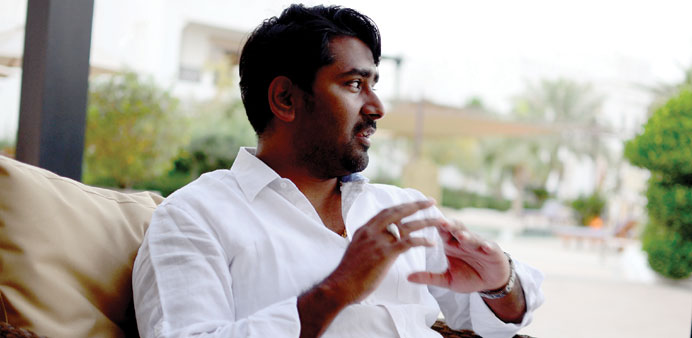
DETERMINED: Settled in Doha with an exacting job as a media manager at Al Jazeera Network, Christy Siluvappan may be the unlikeliest of late-blooming indie film producer prototypes. Photo by Anand Holla
By Anand Holla
On one of the cooler April evenings, Christy Siluvappan sits by the pool at a spa near Corniche and looks as content as a successful first-time film producer could.
“The challenge was to challenge ourselves,” he says, when asked about the backbreaking task of helming his debut Tamil film Kuttram Kadithal — The Punishment, which won the Best Tamil Film award at the 62nd National Film Awards of India, earlier this year, and has been travelling film festivals all over.
“It’s very difficult to know when we can actually feel satisfied. The question is when can we put a full stop, and say alright, this shot is good,” he says, pausing for words, “So the biggest challenge was always within.”
Settled in Doha with an exciting and exacting job as a media manager at Al Jazeera Network, Siluvappan may also be the unlikeliest of late-blooming indie film producer prototypes. Yet, to him, it was only natural that he did this.
“Film-making has always been my passion, and the language of cinema isn’t new to me,” says the 30-something, who started out as a video editor and a photographer, and has done everything, from being a cameraman to a colourist, “I was into the industry, but I wasn’t in the industry.”
In the time that he wouldn’t be busy building workflows and frenetically ideating at his job here in Doha, Siluvappan’s long-bred passion struck harmony with his creative side and thus came together Kuttram Kadithal.
Directed by debutant Bramma G, the taut drama tells the story of 24 hours in the life of a young female teacher who has married against her family’s wishes, and is trying to start a new life with her beloved engineer husband. Things go awry when she encounters a person she has never met in her life. Soon, she finds herself being chased by the police and the media. She flees the city and becomes Most Wanted overnight.
The first vestiges of the film can be traced back to a little tea shop in Chennai, India, around two-and-a-half years ago. “That day, Bramma and I began discussing about making a film because we had been thinking about it for the longest,” Siluvappan shares, “I have been living in Qatar for nine years, and as a Non-Resident Indian (NRI), my heart was always longing to do something back home.”
Like his theatre writer-director friend Bramma and others, Siluvappan, too, was a theatre artiste. “So we decided that all of us theatre friends should get together and make this happen,” he says. From the film’s sound designer to the editor, everybody was a friend or a friend of a friend.
As they began hashing out the script, Siluvappan and Bramma — who had a regular government job — agreed on two things: keep it close to reality and keep it quick. “The narrative had to be pacy,” he says, “as the current crop of audience is mostly interested in a film that is running, throbbing.”
Since the narrative follows a slew of fascinating characters, the camera “is merely an observer in these people’s lives.” Siluvappan says, “We didn’t try to write much and etch out a character. We actually let characters perform and then we observed them and captured them.”
An intriguing casting choice was Master Ajay, who was handpicked from a children’s home in Chennai. “We were looking at a lot of fine faces but a fine face is not what we wanted. We wanted a face like Ajay’s,” Siluvappan says of the boy whose face and demeanour packs in a ton of emotions that words may not convey, “He has perhaps gone through a lot, and it shows.”
Last May, the shoot was wrapped up, in just 55 days. Initially, the crew decided to make do with Canon 5D Mark II. “We eventually decided to shoot it with Red digital cinema camera as I knew that there would be a massive perceptible difference in the results,” Siluvappan recalls, “It was a big decision for me because suddenly the production cost skyrocketed. But we wanted that look.”
What was definitely kind on the pockets of the producers — JSK Film Corporation, and Siluvappan’s Chris Pictures — is the premise of the film. “Since it was the first film for all of us, we wanted something real, like a story we could easily connect to. Even better that this plot suited our budget,” he says and laughs.
The idea was to just make a film. “A good film,” Siluvappan stresses on ‘good’, “That’s it.” So when he saw the finished film hot off the cinematic oven the first time, Siluvappan felt content. “Whatever happens thereafter is all commercial. Awards and acclaim are all welcome, but our focus was to complete the film the way we had written.”
In an unconventional move, more so for an enthusiastic debut brigade, they decided to not release it. “Having won the National Award for the previous year, Satish Kumar, of JSK, came on board also as a producer and helped take the film to various avenues, including International Film Festival of India (IFFI), 2014,” Siluvappan says.
Siluvappan sees something special in how when the National Awards in India were announced, Qatar’s Emir visited India. “I was flying down from Qatar to India and I sensed that I was part of this interesting collaboration that was happening between the two countries,” he muses.
“Qataris are huge consumers of Bollywood cinema. If you have any doubt about that, you can find out for yourself by catching the Hindi films being shown at Villaggio or City Center,” Siluvappan says, “That’s why I feel Qataris must invest in Indian films which are terrific investment options. As a producer, when you invest wisely in Indian cinema, you are very likely to get double or triple returns.”
For expats, it’s all the more arduous to pursue their passion while tackling their regular job — Siluvappan knows this because he has been through it. “You can do what you desire to do only if you have the passion,” he says.
“I had tried making a film here in Doha, but it didn’t work out. It’s very tough because both your office work and film-making are full-time jobs. Doing the two together and doing them well is difficult. I have met a lot of NRIs who want to make movies, but they have concluded that it’s too difficult to pull off. I say if you put your heart into it, you can make it — like I did,” he points out.
For instance, for several months on end, Siluvappan would fly to Chennai on weekends to work on Kuttram Kadithal. “I had to,” he says, “You cannot do these things if you don’t connect.”
The film is slated for a worldwide release in May, including in Doha. Looking back, Siluvappan maintains that the most complex bit was challenging their minds over whether they did the right thing.
“After making a film, you might be satisfied, but you don’t know what others think until you get some recognition or people’s reactions,” he explains, “At the end of the day, you are making a film not for yourself, but for others. And yet, we must satisfy ourselves first, before thinking of others.”
As prolific a writer as Bramma is known in his circle back home, execution is what torments an indie filmmaker’s debut. “For a scriptwriter who has never been a director, it’s a massive challenge,” Siluvappan reasons, “That’s because he will keep referring to his papers and make sure those written scenes come alive on screen, just that way, or else he won’t stop.”
That obviously meant a crazy work schedule that knew no boundaries of the clock. “Every scene that Bramma shoots, he simply refuses to compromise. So I had to keep reminding him in a nice, diplomatic way, that you know, every film kind of still requires improvisation,” Siluvappan says, and laughs.
Just as everything came together for the cast and crew of Kuttram Kadithal, serendipity, too, extended a warm, if somewhat spooky, hand to the film’s protagonist Radhika Prasidhha, who plays Merlin, the teacher.
“It was the first day of our shoot and we checked into a college hostel far from Chennai. Radhika went to her room to find that somebody had written Happy Birthday Merlin on the wall,” Siluvappan recounts, “She ignored it as a prank and later confronted us over it. None of us had written that.”
What could it mean? “I think the birthday message signified the birth of that character Merlin,” Siluvappan says, and smiles, “Only later, we learnt that it wasn’t intended for her. It was written some time back for a girl named Merlin who stayed there. Incidentally, Radhika met that Merlin a year later. Whatever it was, it felt like a blessing.”