


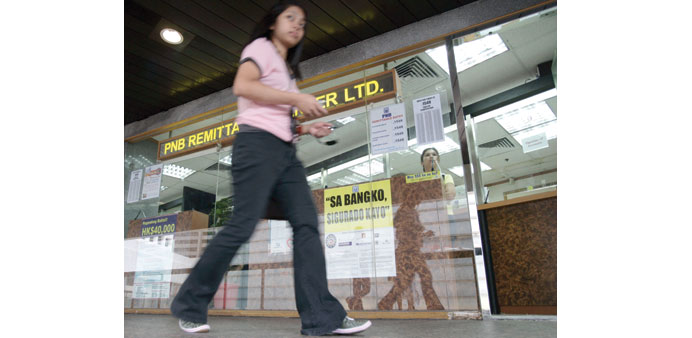
A Filipina walks past a branch of the Philippines National bank in Central Hong Kong (file). According to the Philippine’s central bank, in the first two months of 2015, remittances by Overseas Filipino Workers were up by just 2.4%, which is one of the weakest growth rates for remittances in years.
By Arno Maierbrugger Gulf Times Correspondent Bangkok
Slowing growth of remittances by Overseas Filipino Workers (OFWs) to their home country have alerted economists that there might be a sustained weakness in these important cash transfers as long as low oil prices are impacting employment prospects and wage growth for migrant workers, especially in the Gulf states.
According to the Philippine’s central bank, in the first two months of 2015, remittances were up by just 2.4%, which is one of the weakest growth rates for remittances in years. The growth so far is also clearly below the Philippine government’s initial forecast for annual remittance growth of 5.5% in 2015, after remittances in 2014 grew 8.5% over 2013 to an all-time high of $28bn, according to World Bank figures. Remittances contributed 8.5% to the country’s GDP last year and were a whopping 38% of export revenue of goods and services, but this year these shares could be shrinking.
Banking group Standard Chartered said in a recent note that cash inflows from the Middle East to the Philippines could ease over a longer period in case oil prices remain at current low levels. Around a third of the entire OFW population globally, or an estimated 2.6mn people, is working in the Gulf, and the main source countries there for remittances are Saudi Arabia, the United Arab Emirates, Qatar and Kuwait. Due to more cautious expenditures of Gulf governments in the wake of lower oil income and scaling down of some large projects, hiring of new Filipino workers has also slowed down in the recent past, according to local recruitment agencies. Standard Chartered’s analysis is supported by a World Bank report released on April 16 which expects that growth in the Middle East will be flat for at least the coming two years, and the low price of oil will cut $215bn from combined state revenue this year in the Gulf Cooperation Council countries alone, or 14% of their combined GDP, which certainly will be negatively reflected in the migrant labour sector and, as a result, in remittances.
But the low oil price is not the only problem for OFWs’ earnings. According to Standard Chartered, remittances to the Philippines from Asia, especially from Singapore, Hong Kong, Taiwan and Japan, where many of the other OFWs are working, contracted for three consecutive months due to continued economic weaknesses in those countries. Growth in remittances from Europe, where most OFWs are working in the United Kingdom, as well as in Italy and other Eurozone countries, declined for eight consecutive months. Those who are getting their salaries in euros face the additional problem that the value of the European currency slumped significantly in the past few months compared to both the US dollar and the Philippine peso.
The Philippines is the third largest remittance recipient in the world, only behind India and China, which received remittances of $70bn and $64bn, respectively, in 2014. Mexico and Nigeria are next on the list, having received $25bn and $21bn, respectively, last year. Total global remittances in 2014 reached $583bn, a 4.7% growth from 2013. This year, global remittances are forecast to grow by just 0.4% to $586bn, the slowest growth rate since the global financial crisis of 2008.