


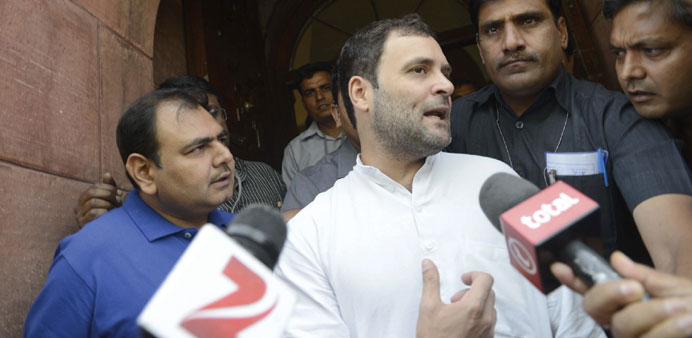
Congress vice president Rahul Gandhi speaks to reporters outside the Parliament House in New Delhi yesterday.
IANS/New Delhi
Congress vice president Rahul Gandhi yesterday accused the government of floating a “trial balloon” on Net neutrality even as Communications and IT Minister Ravi Shankar Prasad said the authorities were in favour of free and fair access to the Internet.
In his second intervention in the Lok Sabha, the lower house of parliament, since his return from a 56-day sabbatical, Gandhi raised the issue of Net neutrality and said: “Every youth should have a right to the Net. But the government is trying to hand over the Internet to some corporates.”
He said: “I would request the government to please change the law or make a new law to ensure Net neutrality.”
The 44-year-old Congress leader continued with his support for Net neutrality outside the parliament as well.
“If the government wanted to protect Net neutrality, why did it begin a consultation? It is a trial balloon to see if the reaction is strong. We are giving a strong reaction so that the process is closed.”
Gandhi also found support in the new general secretary of the Communist Party of India (Marxist), Sitaram Yechury, a member of the Rajya Sabha, the upper house.
“I think ours is the only party which has passed a motion on this in its national congress,” Yechury said.
Prasad, who also spoke both inside and outside the parliament, said: “This government appreciates the Net activism of the youth. Our prime minister (Narendra Modi) has said we have to make the Net available without discrimination.”
The minister said there was, indeed, the need for mobile governance, and the government wanted the Net to reach everybody.
“Neither is our government under pressure of any corporate nor will it ever be.”
Referring to the Telecom Regulatory Authority of India (TRAI) initiating a debate on the issue, the minister said the watchdog has the mandate to debate, but it is the government that has the power to take a decision.
“We want to ensure Internet for everybody. We have asked for a report within two weeks.”
Prasad said the Congress should also answer questions why in August 2012, the twitter handles of some people had been blocked.
The minister’s comment created a furore in opposition benches.
Gandhi sought to ask a clarification “of ten seconds”. But Speaker Sumitra Mahajan refused permission.
Network neutrality, or open inter-working, means that in accessing the Internet, one is in full control over how to go online, where to go and what to do as long as these are lawful. It advocates that firms that provide Internet services should treat all lawful Internet content in a neutral manner.
In March, TRAI released a paper inviting comments from users and companies on how over-the-top services should be regulated in the country. It has asked stakeholders to send suggestions by tomorrow and counter-arguments need to be submitted by May 8.
A committee on Net neutrality was also set up by the Department of Telecommunications (DoT), which will submit its report by the second week of May to help the government make a comprehensive decision on the contentious issue.
Rahul reacts to Obama praise for Modi
Congress vice president Rahul Gandhi yesterday mentioned US President Barack Obama’s praise for Prime Minister Narendra Modi in the latest issue of Time magazine and called it a “first time.” He said he was “at the Congress president’s (Sonia Gandhi) house and I saw Time magazine... Obama ji has written a long article praising Modi. It is perhaps the first time in 60 years a US president has praised someone like this. Obama is not a small man... The world’s biggest industrialists are in the US...Earlier, the US presidents used to praise (former Soviet leader Mikhail) Gorbachev.” Even though the Gandhi scion felt it was the first time an Indian prime minister has been praised by a US president, Obama has earlier heaped praise on former prime minister Manmohan Singh as well. In June 2010, at the G20 summit in Toronto, Obama had praised Singh as a statesman and said: “I can tell you that here at G20, when the prime minister speaks, people listen.”