Bloomberg
Mumbai
Indian stocks dropped for a fifth day, with the benchmark index at three-week low, as healthcare companies and software makers fell amid concern that quarterly earnings may lag behind estimates.
Sun Pharmaceutical Industries posted its biggest loss since June 2009 after Daiichi Sankyo Co sold its stake worth $3.2bn in the drugmaker. Hindustan Unilever, India’s biggest home products maker, tumbled the most in three months. HCL Technologies retreated to a three-month low after its earnings missed estimates.
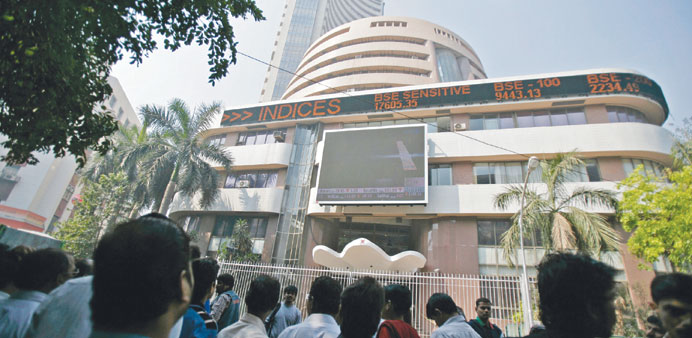
The S&P BSE Sensex decreased 0.8% to 27,676.04, the lowest close since March 27. The measure retreated 1.5% last week after Tata Consultancy Services, the country’s most valuable company, on Thursday reported a drop in quarterly profit. Sensex companies’ earnings-per-share will probably fall for a second straight quarter, according to analyst estimates compiled by Bloomberg.
“Every research house has downgraded earnings for fiscal 2015, and we will soon see fiscal 2016 numbers being ratcheted down,” Anil Ahuja, the Singapore-based chief executive officer of IPEplus Advisors, said in an interview with Bloomberg TV India today. “We’re heading into a weak earnings season.”
UBS on Monday cut its December target for the CNX Nifty index of 50 companies by 4% to 9,200, citing a slowdown in profit growth. Macquarie Capital Securities India Pvt., the most accurate index forecaster for the past two years in Bloomberg surveys, trimmed its earnings forecast for companies in the gauge by 2.2% for the year through March 2016.
Expectations that Prime Minister Narendra Modi will make it easier to do business in India have helped put the Sensex among the world’s best performers in the past year. The index trades at 15.5 times projected 12-month profits, compared with the MSCI Emerging Markets Index’s multiple of 12.4. Valuation for the Indian gauge reached a four-year high in March.
“The market paid for reforms expectations from the new administration through elevated valuation, and now, wants to see hard evidence of that,” Timothy Moe, chief Asia Pacific equity strategist and co-head of Macro Research in Goldman Sachs Asia, said in an interview to Bloomberg TV today. Policy changes “will be the next main catalyst for the market to resume its upward momentum,” he said. Indian lawmakers are debating legislation, including a bill on buying of land for industrial use, as the second part of the parliament’s budget session began Monday.
Global investors sold a net $227.3mn of local shares on Monday, the biggest outflow in three months. They’ve pulled $386mn in four days through yesterday, the most since the period ended Jan. 9. This year’s inflows of $5.9bn are still the highest in Asia after Japan.
Meanwhile the partially convertible rupee erased all its early losses and ended stronger at 62.8500/8600 per dollar, versus its previous close of 62.91/92, after some state-owned banks were spotted buying dollars on behalf of the central bank, traders said. Also, dollar sales by exporters helped. The rupee earlier fell to 63.1550 per dollar, its lowest since January 8.