


Reuters /London
The prospect of Scottish Nationalists holding sway over a minority Labour government is “frightening”, Prime Minister David Cameron said yesterday, as polls suggested deadlock 18 days before an election.
The Scottish National Party could win 53 out of 59 seats north of the border, according to recent forecasts, giving a party whose aim is an independent Scotland huge influence over a British parliament where no single party commands a majority.
SNP leader Nicola Sturgeon said the SNP and Labour, which are both left of centre, could “work together” to prevent Cameron from regaining power.
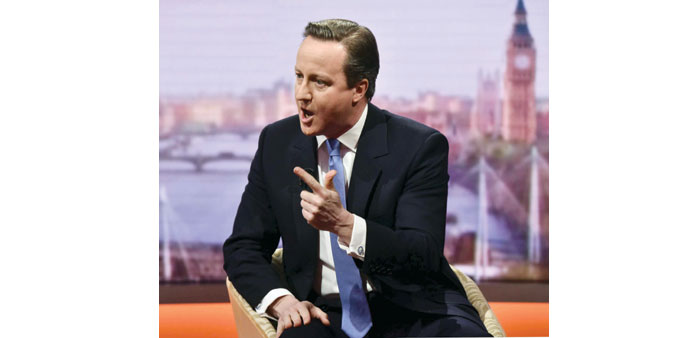
Cameron told the BBC that such a deal would give the SNP powers over policies that affected all the UK to politicians who wanted the demise of the nation.
“This would be the first time in our history that a group of nationalists from one part of our country would be involved in altering the direction of the government of our country,” he said. “I think that’s a frightening prospect.”
The SNP lost a referendum on an independent Scotland last year, but the party has seen its support surge after it won a raft of concessions from central government in Westminster.
“It’s possible to change the direction of government on individual issues without bringing that government down; that puts a party like the SNP, if we have the influence, into a very, very powerful position,” Sturgeon told the BBC.
“It’s about the influence you exert over the lifetime of a parliament,” she said, adding that the SNP wanted to be a constructive force for people across Britain.
Labour, whose decades-old Scottish power base is on course to be wrecked by the SNP at the May 7 vote, said Cameron’s focus on the Scottish Nationalists smacked of desperation as the Conservatives failed to connect with voters.
“He has nothing to say about a better Britain for working families so he’s talking up the SNP as his last best hope of clinging onto power,” shadow finance minister Ed Balls said.
The Liberal Democrats have lost public support since 2010, when they became junior partner in the current Conservative-led government, but even with fewer seats it could once again hold a decisive role if there is an election stalemate.
Business Minister Vince Cable said the party had difficulties with both the Conservatives and Labour, but it was “willing to work with other parties in the national interest”.
The anti-EU United Kingdom Party (Ukip), which pollsters say might win a handful of seats, could wield power out of all proportion to its size if Cameron fell just short of a majority.
While Cameron warned about the SNP’s potential power as a king maker, he refused to rule out a deal with Ukip, despite saying he was fighting for a clear cut victory.
Prime Minister David Cameron gestures during an interview on The Andrew Marr Show in London yesterday.
Prime Minister David Cameron gestures during an interview on The Andrew Marr Show in London yesterday.