


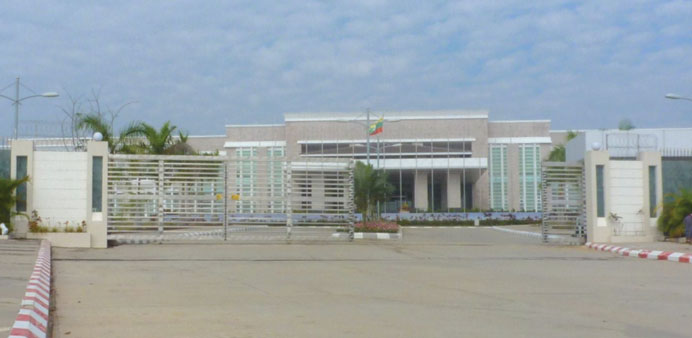
A view of the Central Bank of Myanmar. The Myanmar government has early this month granted the final regulatory approval through the central bank to three foreign lenders to start operations: Japan’s Bank of Tokyo Mitsubishi and Sumitomo Mitsui Banking Corp, and Singapore’s Oversea Chinese Banking Corp.
By Arno Maierbrugger/Gulf Times Correspodent/Bangkok
Next week, on April 23, the first foreign banks since decades will open branches in Myanmar, almost exactly 52 years after the banking sector in the country was nationalised on June 1, 1963, and all foreign banks that were active in what was then Burma were expelled or placed under government control.
The current reformist government in early April 2015 granted the final regulatory approval through the Central Bank of Myanmar to three foreign lenders to start operations: Japan’s Bank of Tokyo Mitsubishi and Sumitomo Mitsui Banking Corp, and Singapore’s Oversea Chinese Banking Corp. This followed the granting of provisional licences to a total of nine foreign banks in October last year after a heated race among 25 bidding banks.
The six other winners — still subject to approval to open their own operative branches — are Mizuho Financial Group (Japan), Australia & New Zealand Banking Group, Bangkok Bank (Thailand), Maybank (Malaysia), United Overseas Bank (Singapore) and Industrial and Commercial Bank of China. They are expected to submit applications for their operating licenses in the coming months after final preparations to set up their business are complete and all official requirements are met, the central bank said.
The operating licences, however, turned out to be quite restrictive and are limiting the business to just one branch per bank, and so far also are preventing them from retail operations. The banks are required to hold at least $75mn in paid-in capital. They can provide loans to foreign companies and domestic banks, but only in foreign currency, and offer other commercial banking services such as cash management, project financing, trade finance, cross-border financing, treasury and capital markets advisory, handling of foreign direct investments and provision of banking services to local corporates in partnership with local financial institutions.
Most of the foreign banks said they will also offer Internet banking facilities for corporate customers for the first time in Myanmar.
The licensees are only allowed to operate for an initial 12-month period before being given a long-term license to do business in the country, according to Myanmar’s central bank. In about “four or five years,” the central bank will then decide whether the foreign banks “benefit the market or not” and might consider to additionally allow them retail banking operations.
However, this is still a great step for Myanmar. Although the central bank has allowed 43 banks to operate “representative offices” since 1993, they were barred from most services and only allowed to deal with foreign companies and joint ventures, as well as domestic banks in Myanmar.
Interestingly, neither US nor European banks joined the license bidding process, nor banks from the Middle East. While some the former argued that they were hesitant because of perceived risks as certain US sanctions against Myanmar are still in place, it is noticeable that no Middle Eastern bank has apparently shown interest in a banking license in Myanmar and none has a representative office, not even a bank from Qatar, despite having huge investments in the country through its telecom operator Ooredoo.
Apart from the new foreign banks, Myanmar currently has four-state owned banks, 23 privately-owned domestic banks and ten finance companies engaged in leasing and other financial services. The biggest bank by assets is Kanbawza (KBZ) Bank, which now entered a partnership with Sumitomo Mitsui.
Around 95% of Myanmar’s population is considered “unbanked”, which means that just 5% actually have a bank account and access to financial services. The country’s finance ministry aims to reach a “banked” rate of over 30% by 2020.