Reuters/Lanus, Argentina
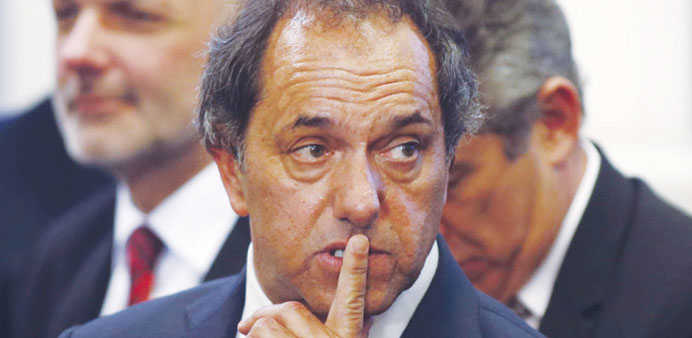
Daniel Scioli, the front-running candidate for the ruling party ticket in Argentina’s presidential election, has a new buzz word: “gradualismo”, or “gradual change”.
It is hardly a slogan to set the campaign trail ablaze ahead of the October 25 election. Instead it illustrates the tightrope act he needs to pull off as he tries to win the support of outgoing leftist President Cristina Fernandez’s loyalists while tapping a rich vein of undecided voters demanding change.
Argentina’s next president will inherit a broken economy by most standards: inflation running at 20%-25%, low foreign reserves, a gaping fiscal deficit fuelled by hefty subsidies, negative real interest rates and a debt default.
Scioli, a 58-year-old former power boat champion who lost his right arm in a crash in 1989, is governor of Argentina’s most populous province, Buenos Aires.
A moderate within the broad Peronist movement that has ruled Argentina for all but eight years since the return of democracy in 1983, he is more pragmatic and pro-market than Fernandez and says policy changes are needed to get the economy moving.
But he says he will move carefully rather than the fast approach proposed by his main rival Mauricio Macri, the conservative mayor of Buenos Aires city.
“We believe in doing everything slowly so that the social effects aren’t too severe,” said Jorge Telerman, Scioli’s campaign spokesman.
Scioli’s first task is to win the ruling Front for Victory’s primary election in August and lock in its supporters, who could make up 30% of voters. Without that, his presidential bid is dead.
Scioli was vice president to Fernandez’s late husband and predecessor Nestor Kirchner from 2003 to 2007.
He is seen as the only figure inside Fernandez’s party with any hope of winning the election so they need each other, but they are not close. Government officials say relations have been strained by differences of policy and personality.
“If Scioli breaks from Cristina, he loses the primary,” said one presidency insider. “But without Scioli we are left with just 30% of the vote in the election, because we won’t gain the (independent) votes Scioli would bring.”
Although much more pro-business than Fernandez, Scioli has backed her government’s nationalisation of energy company YPF and the national airline, Aerolineas Argentinas.
He needs to persuade Fernandez loyalists that he does not represent a dramatic lurch away from her populist policies.
“If Cristina endorses Scioli then I’ll vote for him. But if he distances himself from her then he’ll lose my vote,” said 27-year-old Adrian Ponce as he handed out fliers for a tarot card reader in Lanus, a working class district south of the capital Buenos Aires. “He’s got a tough path to walk.”
Like many low-income Argentines in Lanus’s shabby streets, Ponce’s family has received generous welfare payments from Fernandez’s government. He would vote for her again if the constitution allowed her to seek a third term.
If Scioli wins the primary, he will then try to persuade swing voters he will reduce heavy-handed state controls, lure more investment and haul down inflation.
It is shaping up to be a tight race. An April 13 poll by Ricardo Rouvier & Associates gave Scioli 26.2% support, with Macri on 23.3% and Sergio Massa, a former Fernandez ally who broke ranks in 2013, third with 17.5%.