


AFP/Tokyo
Japan’s top whaling negotiator said yesterday Tokyo would try again to justify its “scientific” Antarctic Ocean hunt after a panel of experts said the government had not proved why it needed to kill the mammals.
Joji Morishita, Japan’s commissioner to the International Whaling Commission (IWC), said he and his fellow officials would do their best to meet demands for evidence their hunt is scientific, with the Japanese government determined to restart what it claims is research.
“We respect their recommendations and we will make the best effort to respond to their recommendations, in good faith and in a sincere manner,” Morishita told journalists in Tokyo.
“Our draft research plan is a draft from page one to the end, so all parts of the research plan can be improved, amended or changed in the course of the discussion.”
Despite international disapproval, Japan has hunted whales in the Southern Ocean under an exemption in the global whaling moratorium that allows for lethal research.
It makes no secret of the fact that meat from the animals - killed ostensibly for research - is processed into food.
The International Court of Justice - the highest court of the UN - ruled in March last year that the research was a fig leaf for a commercial hunt and ordered that it end.
After that ruling, Japan said it would not catch whales during this winter’s Antarctic season but has since expressed its intention to resume “research whaling” in 2015-16.
Japan tinkered with its programme and submitted a new plan to a panel of experts from the IWC. Amongst other things, the plan reduced the annual catch target to 333 from 900, and put a 12-year limit on the research.
That panel on Monday said there was not enough evidence supporting why the whales need to be killed if Japan really wants to find out what they eat and how old they are.
“I believe our experts did a very scientific and technical job as... expected,” Morishita told reporters.
“As you might know, oftentimes even scientific discussion at the International Whaling Commission can become, I should say, political or emotional because of positions taken by the governments.”
He added Japan would fine tune the plan before a meeting of the IWC’s science committee in San Diego next month.
“We will see how that will develop at the scientific committee itself in... May,” he said.
Japan has said it believes the world’s whale population, especially the stock of minke whales, is sizeable enough to accommodate a return to sustainable whaling.
It argued in its proposal to the IWC that knowledge gained by the research killing would help the IWC calculate sustainable levels for hunting.
Lethal research should also lead to a better understanding of the Antarctic marine ecosystem, Japan maintains.
Last month Japanese whaling ships returned from the Antarctic without a single whale, after carrying out what they said was “non-lethal” research, such as sightings.
It was the first time since 1987 when the country began the annual “research” hunt in the Antarctic, according to local media.
Despite having had a target of 900 animals, Japan killed just 251 minke whales in the Antarctic in the 2013-14 season and only 103 the previous year, with the aggressive interventionist tactics of conservation group Sea Shepherd blamed.
Rare Omura’s whale washes up in Australia
A rarely seen Omura’s whale has washed up in Australia, only the second sighting nationally and one of the few globally, exciting scientists who know little about the species, officials said yesterday.
The dead whale was found on a remote beach near the town of Exmouth, 1,265km north of Perth, in the wake of Tropical Cyclone Olwyn which hit the region last month.
Western Australia Environment Minister Albert Jacob said it was the first record and sighting of the species in the state and only the second nationally.
“This find is highly significant for whale scientists in Western Australia and researchers globally because there have not been many recorded sightings of this species so very little is known about it,” Jacob said.
“Omura’s whale was only described in scientific journals for the first time in 2003 and is apparently restricted to tropical and subtropical waters.
“The knowledge we gain from this whale will help to improve field identification guides to better understand the whale’s regional distribution,” he added.
“Scientists know a fair bit about many whale species but this exciting discovery shows there is still so much more to learn in our oceans.”
According to the International Union for Conservation of Nature, only a handful of specimens have been found before, including in the Sea of Japan and the Solomon Sea. There is no population estimate, given the scarcity of information about them, with little known of the species’ ecology and virtually nothing about its reproductive biology.
Jacob said identifying the 5.68m juvenile female was difficult for the state’s Department of Parks and Wildlife, but DNA profiling confirmed it was an Omura’s whale.
The animals, which have a streamlined and sleek body shape and several unique skeletal features distinguishing them from other whales, are often incorrectly identified as a small Fin whale or Bryde’s whale.
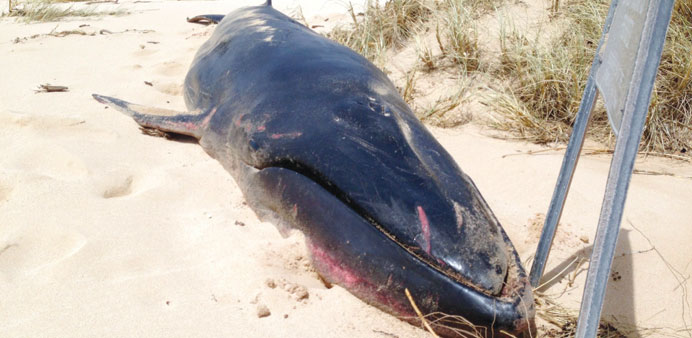
A handout photo of the rarely-seen Omura whale that was found dead on a remote beach near the town of Exmouth.