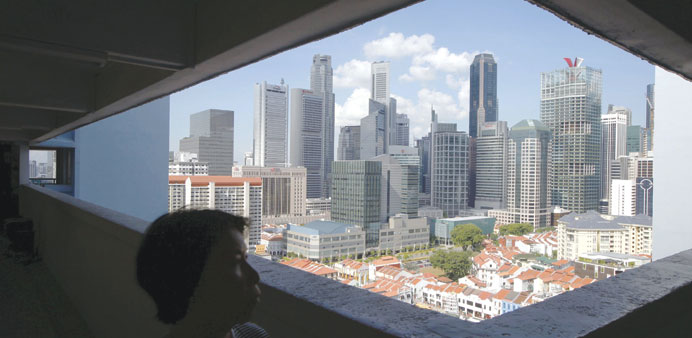
A woman looks at the skyline of the central business district in a public housing estate in Singapore. The island nation’s central bank yesterday said it will maintain the policy of a modest and gradual appreciation without adjusting the pace of its currency’s moves.
Bloomberg/Singapore
Singapore joined regional peers in refraining from easing monetary policy further after economic growth last quarter beat analysts’ estimates.
The Monetary Authority of Singapore said yesterday it will “maintain the policy of a modest and gradual appreciation” without adjusting the pace of its currency’s moves. Gross domestic product rose an annualised 1.1% in the three months through March from the previous quarter, the trade ministry said separately. The median estimate in a Bloomberg News survey was 0.2%.
A faltering growth outlook, coupled with the nation’s longest disinflation streak since the global financial crisis, had put pressure on the central bank to add to an unexpected January policy easing. While cheaper crude has contributed to falling consumer prices, officials have said Singapore’s economy stands to benefit on the whole as a net oil importer.
“It’s a reflection that growth is not at risk of falling beneath the government’s forecast,” said Wai Ho Leong, a Singapore-based economist at Barclays. “It’s a recognition that the economy could benefit from lower oil in the second half of the year.” The Singapore dollar jumped 0.7% to S$1.3619 against the US currency as of 9:13 am local time. It has fallen about 2.7% against the greenback this year.
Singapore is joining counterparts including Australia and India that in recent weeks have held off on adding to monetary easing executed earlier this year amid uncertainty over when the Federal Reserve will raise interest rates.
“Central bankers across the region are in wait-and-see mode because they’re still trying to gauge what the Fed is up to,” said Frederic Neumann, co-head of Asian economics research in Hong Kong at HSBC Holdings. “Once the Fed’s tightening path becomes clear, Asian central bankers may resume their easing cycle,” given weaker growth in China and declining inflation, he said.
The Monetary Authority of Singapore yesterday surprised markets by keeping its currency policy unchanged, saying that it expects the economy to grow at a moderate pace and that inflation is likely to remain subdued this year.
The decision marks a pause in the rash of easing so far this year, as central banks from China to India have cut interest rates to boost growth. Last week, Australia’s central bank also surprised markets by leaving its interest rate unchanged, and late Tuesday Bank Indonesia decided to keep its policy interest rate at 7.5%.
Singapore’s central bank cited a slightly improved global economic outlook and low inflation for its decision to keep its policy steady.
Singapore’s central bank, which uses the currency rather than interest rates to manage inflation, reduced the pace of the local dollar’s appreciation against those of its trade partners in an unscheduled decision on January 28, after growth sagged in 2014 to its weakest in five years. Eight of 15 economists surveyed by Bloomberg predicted the MAS would maintain the overall policy stance today, while the rest forecast it would ease.
The MAS guides the local dollar against a basket of its counterparts and adjusts the pace of its appreciation or depreciation by changing the slope, width and centre of a currency band. It doesn’t disclose details on the basket, or the band or the pace of appreciation or depreciation.
“The outlook for the global economy has improved slightly, anchored by a stronger recovery in the G3,” the MAS said yesterday, referring to the US, Japan and euro area. “The sustained, albeit uneven recovery in the global economy should provide a mild uplift to the external-oriented sectors in Singapore.” The central bank reiterated its forecast for the economy to grow 2% to 4% this year.
The economy expanded 2.1% in the first quarter from a year earlier, matching the pace in the previous three months, the trade ministry said today. The median estimate in a Bloomberg survey was for a 1.7% gain.
Manufacturing shrank an annualized 2.3% in the first quarter from the previous three months, following a 2.5% contraction in the fourth quarter. Construction expanded 13.8%, while services fell 0.4%.
Yesterday’s data are advance estimates computed largely from figures in the first two months of the quarter and may be revised later, the ministry said.