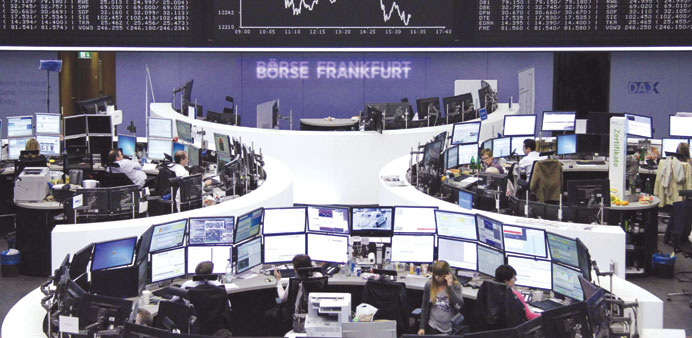
Traders work at the Frankfurt Stock Exchange. The DAX 30 index ended down 0.90% at 12,227.60 points yesterday.
AFP/London
Europe’s main stock markets diverged yesterday after news that Finnish telecoms giant Nokia was in advanced talks to buy Franco-American rival Alcatel-Lucent.
Frankfurt’s DAX 30 index ended the day down 0.90% to 12,227.60 points, while the CAC 40 in Paris fell back 0.69% to 5,218.06 points.
London’s benchmark FTSE 100 index however edged up 0.16% to 7,075.26 points, as investors digested news that British annual inflation held at a record-low zero in March.
Also yesterday, the International Monetary Fund hiked its eurozone growth forecasts but warned the outlook was fragile, with the Ukraine crisis and uncertainty over Greece’s future in the single currency bloc adding to concerns.
The IMF said in its semi-annual World Economic Outlook that the Japanese and European economies were picking up pace as it stuck to its forecast for moderate global growth this year and next.
The IMF trimmed its outlook for the US but said the country would remain the driver of world output in 2015 and 2016 while many emerging economies struggle with low commodity prices and turbulence in financial markets.
It said the plunge in oil prices was not yet generating all the potential benefits of more spending money in consumers’ pockets.
The euro strengthened to $1.0678 from $1.0571 in New York late on Monday, before the European Central Bank’s interest rate decision today.
Nokia revealed yesterday it was in talks to purchase Alcatel-Lucent, with the aim of creating a telecoms and Internet technology behemoth. No price was given.
In reaction, Alcatel-Lucent was the top riser in Paris, surging by almost 17% in initial trade. It closed at 4.481 euros, up 16.00%.
In Helsinki, however, Nokia’s share price plunged 3.60% to close at 7.49 euros.
“Investors have not reacted the way Nokia likely would have hoped,” said Spreadex trader Connor Campbell.
Imran Choudhary, telecoms analyst at Kantar WorlDPAnel, said the potential involvement of the French government and regulators could scare Nokia’s investors off.
“It does not come as a surprise that this could be very tricky for Nokia to pull off and to deliver gains on, which would explain why investors have not reacted positively,” he said.
Craig Erlam, markets analyst at trading firm Oanda, agreed, noting that some 6,000 jobs could be at risk in France.
“On the face of it, it looks like a good deal for both companies,” Erlam said.
However, “given that Alcatel-Lucent develops products that are in direct competition with Nokia, it seems safe to assume that any deal would mean job losses in France, something the French government would likely oppose.”
Finland’s Nokia was the world’s biggest mobile phone maker for more than a decade until it was overtaken by South Korea’s Samsung in 2012.
Then in 2014, Nokia sold its mobile phone and tablet division to US software giant Microsoft, and the company now develops mobile and Internet network infrastructure for operators.
Wall Street stocks also diverged yesterday in volatile trade following a mixed batch of earnings news.
The Dow Jones Industrial Average was up 0.53% to 18,072.80 points in midday trading.
The broad-based S&P 500 added 0.11% to 2,094.64, while the tech-rich Nasdaq Composite Index shed 0.32% to 4,972.09.
Dow member JPMorgan Chase rose 1.5% after first-quarter earnings jumped 12.2% from a year ago to $5.9bn.
Wells Fargo shed 1.5% as earnings slipped 1.5% to $5.8bn on higher expenses. However, the results translated into $1.04 per share, six cents above analyst expectations.