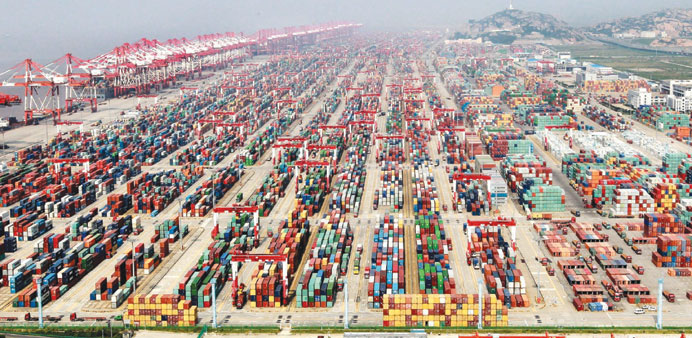
A container pier at Yangshan Port in Shanghai. China’s foreign sales contracted to one year low in March deepening concern about sputtering Chinese economic growth.
Reuters/Beijing
China’s export sales contracted 15% in March, a shock outcome that deepens concern about sputtering Chinese economic growth.
The tumble in exports – the worst in about a year – compared with expectations for a 12% rise and could heighten worries about how a rising yuan has hurt demand for Chinese goods and services abroad, analysts said.
The yuan’s strength was one factor in March’s 19.1% on-year decline in exports to the European Union and 24.8% drop to Japan.
In a sign that domestic demand was also tepid, imports into the world’s second-biggest economy shrank 12.7% last month from a year ago, the General Administration of Customs said yesterday. By volume, coal imports plunged more than 40% in January-March.
The March fall in imports was in line with forecasts, unlike the one for exports.
“It’s a very bad number that was much worse than expectations,” Louis Kuijs, an economist at RBS in Hong Kong, said about the export data.
“It leads to warning flags both on global demand and China’s competitiveness.”
Buffeted by lukewarm foreign and domestic demand, China’s trade sector has wobbled in the past year on the back of the country’s cooling economy, unsettling policymakers.
Chinese Vice Premier Wang Yang was quoted by Xinhua state news agency as saying earlier this month that authorities must arrest China’s export slowdown lest it further dampens economic growth.
Wang was quoted as saying that local governments should offer “preferential policy support” and encourage more private investment in exports.
Anaemic growth in the trade sector could hurt jobs, which the government wants to protect for fear that widespread unemployment could fuel social discontent and trigger unrest.
So far, China’s labour market appears to be holding up well, despite signs that economic growth is steadily grinding to its lowest in a quarter of a century of around 7%. Data on growth in the first quarter will be released tomorrow.
Last month’s trade performance left China with a surplus of $3.1bn, much smaller than the poll forecast for a $45.4bn trade gap. On a quarterly basis, exports appeared to fare better than imports. Export sales were up 4.7% in the first quarter compared with a year ago, improving from a 3.4% fall seen between January and March last year.
Imports, on the other hand, crumbled 17.6% in the first three months from a year ago, reversing the 1.6% increase in 2014’s first quarter.
Yet analysts said a breakdown of the data showed exports in March were clearly crimped by a stronger yuan, which is pegged to a rising dollar.
Indeed, Huang Songping, a spokesman at China’s customs office, acknowledged the difficulties that exporters faced from a firmer yuan. Costs stemming from labour, financing and the exchange rate “remain stubbornly high and the competitive advantage of the traditional foreign trade has been weakened,” Huang said.
He added that 56.2% of exporters surveyed by the government said their costs had risen in March.
Against the euro, the yuan hit a record high of 0.15274 euros on March 16, up a steep 14% against the common currency this year.
That helped to dent Chinese export sales to Europe. Shipments to the European Union had their biggest fall in more than a year, as did those to Japan.
“The really weak trade surplus has implications for the weakness in the renminbi,” said Andrew Polk, an economist at the Conference Board in Beijing. “So we might see more weakness going forward.”
China expanded its trade sector by 3.4% in 2014, according to government data, missing the government’s growth target of 7.5% by more than half.
Taking that disappointing outcome into account, the government has lowered its growth target for 2015 combined imports and exports to around 6%.