


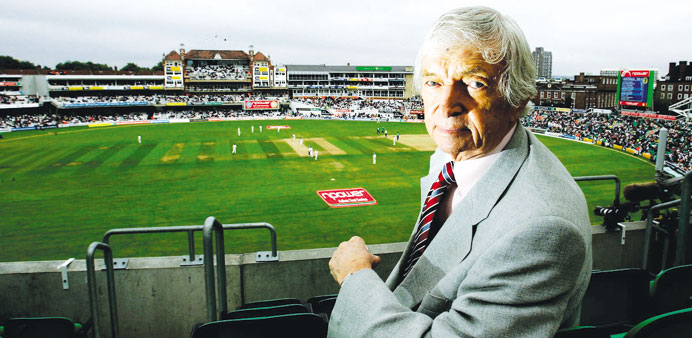
Former Australia skipper Greg Chappell paid tribute to the late former captain of Australia, Richie Benaud, who passed away at the age of 84 after succumbing in his battle against skin cancer in Sydney on Friday.
By Greg Chappell/The Guardian
Richie Benaud epitomised the words of Mark Twain: “The fear of death follows from the fear of life. A man who lives fully is prepared to die at any time.”
Richie led a full and creative life in which fear may have played a very minuscule, inconsequential part. As a cricketer he prepared well and played with abandon. His captaincy was bold and adventurous – and as a broadcaster, he was peerless. I feel like I have known Richie all my life. When I was a youngster our father imbued a love of the game and encouraged us to learn from the best. I can remember as a 10-year-old going to the Adelaide Oval to watch a Sheffield Shield match between South Australia and New South Wales.
New South Wales were led by Richie Benaud and contained six of the then Australian team. Dad had suggested that Benaud, Davidson, Harvey and O’Neill were the players to watch. I followed their every move on and off the playing field. From memory Richie scored some runs in the first innings and took wickets in the second to bowl New South Wales to victory. My other hero, Neil Harvey, scored a scintillating 80 in the first innings.
Even to a 10-year-old Benaud had an air about him. He was cool and aloof, but when I approached him cautiously to collect my first ever autograph he couldn’t have been kinder and warmer. I was a fan from that day and followed his career closely, even modelling myself on him by becoming a leg-spin bowling all-rounder!
My leg-spin didn’t survive the journey as I never overcame growing six inches in one summer holiday period as a teenager, but, luckily, my batting allowed me to follow his footsteps into Test cricket. My next interaction with Richie followed my first Test innings in the first ever Test match in Perth 11 years later. Richie was a commentator by then and was working at that game. Following a successful debut I was interviewed by Richie at the end of the day’s play. At the conclusion of the interview we walked together back across the Waca during which time Richie offered me a piece of advice: “Whatever you do, don’t ever stop playing your shots.”
It was intended to be positive encouragement to a young player, but I misinterpreted the advice and tried to play shots from the start of my innings for the next few Tests and failed to make an impact. Once I learnt that I had to be selective in which deliveries that I attacked, my career gained the benefit of his wisdom.
During the second season of World Series Cricket, some years later, I went through a lean period against the formidable West Indies pace attack, so I sought out Richie for some advice.
My method to that point had always been to expect the full ball and respond to whatever came along, but because the West Indian bowlers were pitching so few balls up, I decided to get on the back foot early to get ready for the short balls. Suddenly I found that I was getting out to full balls and struggling to make the most of the few bad balls that I received.
Richie reflected on my problem for a few moments and then suggested that I go back to doing what had allowed me to be successful to that point. As usual he was spot-on and my form and fluency came rushing back. One of Richie’s great traits was his positivity about the game and towards the playing generations that followed him. He never lived in the past and was effusive about one-day cricket when it came in, and T20 cricket in recent times.
He was always supportive of me – other than the infamous day at the MCG when I ordered my younger brother to bowl underarm against New Zealand. His summation of the day was scathing. I was stung by his criticism because it came from my boyhood hero. He was, of course, entitled to his opinion and, without the knowledge of some of the things going on in the background, he was entirely correct to be affronted by what I did. I made a mistake for which I have expressed my remorse. It is a decision that I wish I had never made.
We never discussed the incident. I didn’t feel the need to and I had no doubt that Richie had said what he felt and moved on. Our relationship was largely unaffected in the aftermath. He continued to be unfailingly generous and gracious in his assessment of me and my career.
Though hurt then, I have never held his comments against him. He was not only professional but extremely supportive when we worked together in the Chanel Nine commentary box.
The Channel Nine commentary team became iconic in the years that Richie led the band of Test match captains – all of whom held him in the highest esteem.
Amazingly it was Billy Birmingham, the satirist, with his Twelfth Man series of parodies of the commentary team, who took them to an even wider audience. Birmingham really “caught” the personalities of Benaud, Lawry and Greig and indeed the commentary box, in a way that endeared them universally. It seemed everyone was practising Richie’s “what a catch” Bill’s “He’s got ‘im” or Greigy’s comments about the “cor pork and the putch report”!
Some of us in the commentary box, too, would practise our Birmingham Benaud-isms, but not when Richie was around! Bill Lawry is the only one that I saw, who dared to do it to Richie’s face and that happened when they were on air together during a domestic one-day game in Hobart in the 90s.
South Australia w playing Tasmania and reached a score of 2/222 which Bill mischievously read as “chew for chew hundred and chwenty chew” including the pouting bottom lip. Bill though it was so hilarious that he put the microphone in his lap and collapsed in paroxysms of laughter. Richie probably saw the funny side of it but he wasn’t going to give Bill the pleasure, by joining in the mirth, so he put his microphone in his lap and stared down his nose at Bill and silently dared him to go on.
Each time Bill picked up the microphone he collapsed into laughter and couldn’t speak. Richie wouldn’t commentate either, so two overs went by without a word while Bill composed himself. Once again Richie showed his dry wit and sense of timing as he had the last laugh, letting Bill stew in the juice of his own making.
Having learnt his commentary on BBC TV, Richie was economic with words and sharp in his observations. A few generations of commentators have learnt from watching the Master at work. He was the voice of the summer in two countries for many years, as he followed the sun from Australia to England and back again.
He led a very full and interesting life, with cricket as the backdrop for most of it. He enriched the game with his love and his knowledge, and graced it by never looking backwards and lamenting the past or the changes. He always looked for the positives in the game and in those who played it. Though the entire cricketing world held him in the highest esteem and great affection, Richie would not want anyone to make a fuss of his passing. He will be sorely missed and the game will be much poorer without him.
Vale the Maestro.