


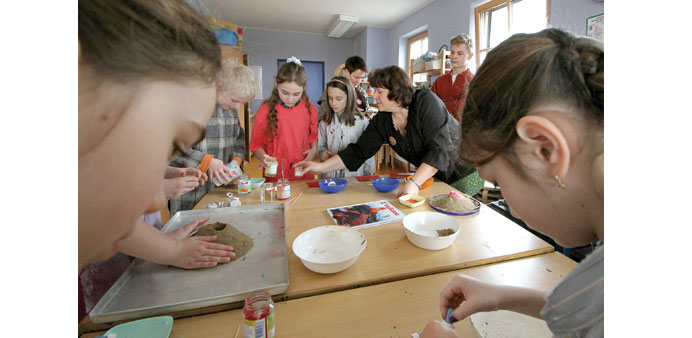
MODELLING A VOLCANO: Czech and German children in the Schkola in Zittau, Germany. The one-day-a-week multilingual education site helps break down prejudice in the tri-border area.
By Christiane Raatz
Piles of brightly coloured cloths lie heaped in front Richard and Jakub, out of which they are supposed to create a landscape.
They come quickly to an agreement— here there’ll be a blue river, there some green fields. And in the middle a mountain will rise up.
Welcome to an unusual programme to counter deep-rooted ethnic resentments at the point where three borders meet, those of Germany, Poland and the Czech Republic.
Words in German and Czech fly around. Richard grabs a white cloth, and arranges it on the top.
“That’s the Lausche, there’s still snow on it,” he says. Jakub laughs and nods. Both know the Lausche well, the highest mountain in the Zittauer range in Saxony, eastern Germany. The German-Czech border lies just beyond its summit.
Once a week, the boys, together with the rest of their school classes, take a short walk over the meadows, crossing the open border, to attend a day of joint schooling.
They meet either in the “Schkola” in the German city of Zittau, or its partner school on the Czech side.
Today, the 9-year-olds are building volcanoes and cars that will be driven along with the help of electric fans. They speak phrases in both German and Czech and the teachers also constantly switch between the languages.
“Our idea is really something special,” says Ute Wunderlich, the director of Saxony’s Schkola schools.
In the Schkola, the German children are taught Polish or Czech from the age of 6, or Year 1.
The lessons are student-centred, rather than that the more traditional teacher-led style common round here. The children work in groups of mixed ages between Years 1 and 3, with older children helping the younger children and a little guidance from the teachers.
A nursery school, a meeting place and six schools — comprising three primary schools, two high schools and a grammar school — belong to the independent network in the Upper Lusatia region.
“The first thing is really just about meeting each other, allaying any fears,” says Wunderlich, who refers to a common belief east of the border that all Germans are rich and arrogant, which finds its counterpoint in a view west of the divide that no Slav can be trusted because everyone is a potential thief.
She knows the tri-border region is not crime free, but says that whether political correctness makes you pretend there is no crime or prejudice leads you to utter slurs about entire ethnic groups, you are making a mistake.
“A lot of theft does happen round here,” she says. “We shouldn’t keep quiet about it. We should talk about it factually.”
The school wants to teach children that the world isn’t just made up of “the Germans” or “the Czechs” of traditional stereotypes, but of individuals.
But Wunderlich believes it will be years before people hereabouts become multicultural. “Our mission is not to preach an idea of integration, but to actually go ahead and just do it,” she says.
The Schkola began as a parent-driven initiative in 1995. The idea then was to set up full-time high schools in the region of east Saxony as an alternative to the public education system.
The basic principle was going to be to offer bilingual teaching and joint lessons with Polish and Czech students, but the authorities refused a licence, says Wunderlich.
So instead, the movement now organises the weekly meetings. The sessions are financed by the regional authorities, but parents must also pay around 60 euros (65 dollars) in fees per month.
The Saxony Education Authority (Saechsische Bildungsagentur) is supportive of the once-a-week encounters, calling them a “jewel” in the state’s educational system.
There are only a few other schools in the border area offering a somewhat more internationally oriented education than is available in regular schools.
In the Augustum Annen grammar school in Goerlitz, German and Polish children can take bilingual classes together from the age of 12. They don’t just learn each other’s languages though, but also about each country’s culture and history.
At the Friedrich Schiller grammar school in Pirna, students from Germany and the Czech Republic can take school-leaving exams that are recognised in both countries.
Wunderlich believes there should be more cross-border education initiatives in the tri-border region to overcome the ancient hatreds.
And there is evidence that there is demand for such schools — the Schkola are taking in a growing number of children.
In the current school year, a total of 517 children are being taught by 71 teachers. When the schools were first founded 20 years ago, 56 students were taught by 5 teachers.
“They’re very popular, the waiting lists are long,” says Wunderlich, adding that there are two to three applicants for each school place.
The Schkola teachers are also a colourful mix, and include Czechs and Americans.
Stephan DiCara comes from the United States, lives in the Czech Republic and teaches English at the Schkola in Zittau.
Overcoming barriers between cultures is normal for an American in Europe, he says: “The children see that I have to cope with all three languages and that I also make mistakes.” At the end of the day, only one thing counts: communication. — DPA