


Agencies/Islamabad
Iran and Pakistan yesterday pledged to work to find a negotiated solution to the conflict in Yemen, as the Saudi-led air campaign against rebels nears its third week.
The military coalition of largely Sunni Muslim countries has been bombarding Houthi Shia rebels in Yemen in a bid to restore the government of fugitive President Abedrabbo Mansour Hadi.
Riyadh accuses Tehran, the major Shia power, of backing the Houthis, but Iranian Foreign Minister Mohamed Javad Zarif insisted his government wanted a swift end to the crisis, which has cost more than 640 lives since March 19.
Zarif laid out a four-stage plan for talks, calling for an immediate ceasefire followed by humanitarian assistance, dialogue among Yemenis and the formation of an “all-inclusive government”.
“It’s up to Yemenis to decide how to do this, we can only facilitate as neighbours... as countries with some influence one way or another,” he said at a joint press conference with his Pakistani counterpart Sartaj Aziz.
“We can all help bring this about but these are the four lines on which my government operates.”
Saudi Arabia has pressed Pakistan, a close and longstanding ally, to join its coalition against the Houthis but Islamabad has so far resisted.
Pakistan has called for dialogue and, in addition to Zarif’s visit, held talks with Turkey on how to push this, while insisting it stood ready to defend Saudi territorial integrity.
Aziz appeared cool on Iran’s idea of an immediate ceasefire, saying it “would consolidate the existing ground position”, which currently has Houthis in control of large parts of Yemen, including the capital Sanaa.
Instead he called for “a more comprehensive resolution on facilitating an intra-Yemeni dialogue to create the possibility of some kind of negotiated solution”.
Saudi Arabia has vowed to bomb the rebels into surrender to prevent them establishing a pro-Iran state on its doorstep.
Zarif rejected the claims in Islamabad.
“We are not bombarding anyone,” he said. “Our planes are not there hitting hospitals and bridges and flour factories.”
Washington is backing the coalition and late Tuesday said it was stepping up weapons deliveries and intelligence sharing in support of the effort.
Pakistan’s parliament is weighing up the Saudi request for troops.
Members of parliament spoke against becoming militarily involved in Yemen yesterday as they resumed a one-sided debate on a Saudi request to join a campaign against Houthi forces in Yemen.
“The Yemen war is not our war...Our advice to the government is that the army should not go,” said opposition member of parliament Shireen Mazari.
Prime Minister Sharif has said he will defend Saudi Arabia’s “territorial integrity” but not spelled out what, if any, commitments he has made.
Mazari said Pakistan would be obliged to defend Islam’s holiest shrines, but there was no present danger to the shrines in Saudi Arabia.
“As Muslims, we are duty bound to counter any threat to holy shrines but there is no such threat today,” she said.
Opposition Senator Tahir Hussain Mashadi said the “aggressors” were the Saudis and the victims were the Yemenis.
“Now the aggressors are asking another sovereign state, Pakistan, to come to provide military aid to Saudi Arabia.”
Pakistan’s parliament began debating the request on Monday and no legislator has spoken in support of sending troops for Saudi to use in Yemen.
On Tuesday, Saudi Arabia presented a gift of 200tonnes of dates to Pakistan, which in return “conveyed the warm sentiments of the people of Pakistan of their Saudi brethren for their love and affection”, the Nation newspaper said.
Although there are many groups in the complex Yemen conflict, Pakistani lawmakers fear it could develop into a proxy war between Saudi Arabia and Iran, and inflame already simmering sectarian tension at home.
Islamabad finds itself in an awkward position on Yemen, reluctant to offend the oil-rich kingdom with which it has long enjoyed close ties but also not wanting to get involved in a war that could fan sectarian tensions at home.
In a related development, Pakistan said yesterday it would investigate the killing of eight Iranian border guards allegedly by Sunni militants based in its Baluchistan province, officials said.
Pakistani authorities asked Tehran to share intelligence to apprehend the terrorists, Foreign Ministry spokeswoman Tasnim Aslam said.
Meanwhile, a group of hardline Sunni Islamist militants based in south-western province of Balochistan claimed reasonability for Tuesday’s attack in an e-mail.
Jaish al-Adl group said all the attackers returned to its base after killing “enemies” across the border and seizing their ammunition. “We will soon issue a video of the assault,” the e-mail said, in English and Persian.
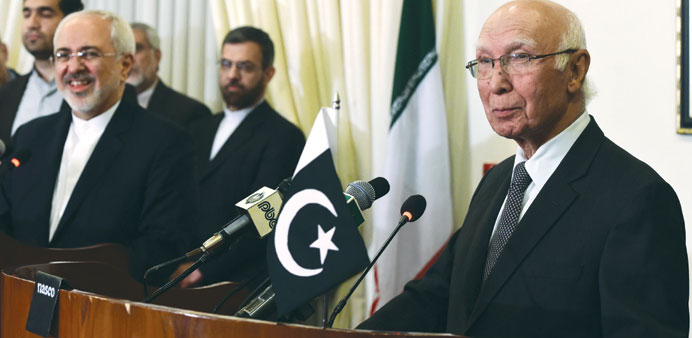
Iranian Foreign Minister Mohamed Javad Zarif listens during a joint press briefing with Adviser to Pakistani Prime Minister on Foreign Affairs, Sartaj