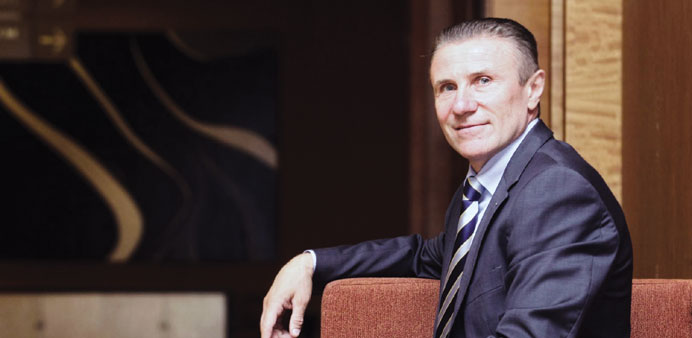
Agencies/London
Sergey Bubka said he would review the flagship World Championships, appoint a CEO for the sport and attract new global sponsors if elected president of governing body IAAF later this year.
The former world record pole-vaulter, who faces another former Olympic champion in Briton Seb Coe in a bid for the top seat, said he wanted the sport to operate more as a business.
“We are very fortunate to be the number one Olympic sport,” said the 1988 Olympic champion who, like Coe, is an IAAF vice-president, in a conference call from Kiev yesterday after announcing his manifesto.
“At the heart of my programme is the most intensive review of athletics that should be done, to make athletics more exciting and more attractive.
“It is my intention to overcome some challenges. How we can engage the youth, how to support (national federations) with innovation, financial support to make them more successful.”
When Bubka and Coe were competing athletics attracted huge TV audiences and often dominated the back pages of newspapers around the world.
Thirty years on, the sport is fighting to make a connection with the next generation. A shortage of recognisable personalities, an ageing audience, a confusing calendar, a continuing struggle to attract interest in the United States and the dark shadow of doping has left athletics fighting for a foothold in an ever-more crowded sporting and leisure landscape.
“We need to run as a business company,” said Bubka, who also said a CEO should be appointed within the international federation to increase efficiency between departments.
“We should also establish a business commission to share experience and knowledge to our sport. We must run our office as a business company but never to forget the love and passion of athletics.”
Bubka, an International Olympic Committee member, said regional and national federations should also be taught to operate as marketing agencies for the sport and generate revenues in their territories.
The IAAF in turn would help them access funds through the International Olympic Committee’s Olympic solidarity budget while also pledging to provide “within a few years” every member federation with a synthetic athletics track for top competitions.
Bubka also said there was room for more global sponsors to sign up with the IAAF in the coming years while also proposing a review of their World Championships after talking to broadcasters and sponsors about the format.
“We should discuss with our broadcasters and sponsors how we can change them, how many days, what we can do for our future revenues,” he said.
Bubka, who is also the Ukraine Olympic Committee president, will challenge Coe for the top post during the IAAF Congress in Beijing, China, in August.
He also said that international athletics needs stronger legal weapons to tackle doping cheats.
The 51-year-old Ukrainian also said that athletics should consider events with men and women competing against each other, but insisted the sport must be defended from cuts for the 2020 Tokyo Olympics as new sports press for places.
Bubka was part of the International Olympic Committee athletes commission that a decade ago started pressing for coaches and other staff around athletes to be punished for doping offences.
Bubka has called doping one of the biggest dangers to 21st century sport. But he said legal restrictions had held back efforts to impose the punishments that athletes wanted.
“It was a very very complicated issue because from a legal point of view you would like to do many more sanctions, you would like to do more punishment.”
But Buka said this had always created legal and human rights issues.
“We need to work together, we need to study legally how we can strengthen our position, in which way we can put sanctions, if we need to put sanctions on a national federation which violates,” he said in answer to a question on whether Russia should face special action over a widespread doping scandal to hit is sports.
“Who is cheating will be punished, no exception for cheaters,” Bubka said, vowing “zero tolerance” if successful in the election.
But the six-time world pole vault champion said tougher sanctions need “deep study.” Many federations are just introducing four year bans for drug cheats and legal challenges are expected.
Bubka said the IAAF should even consider men and women competing against each other as well as staging athletics in shopping malls and other new venues.
“Mixed gender competition—this area may have many opportunities and we must move to this direction.” He highlighted mixed gender races and contests already held in some Caribbean countries.