


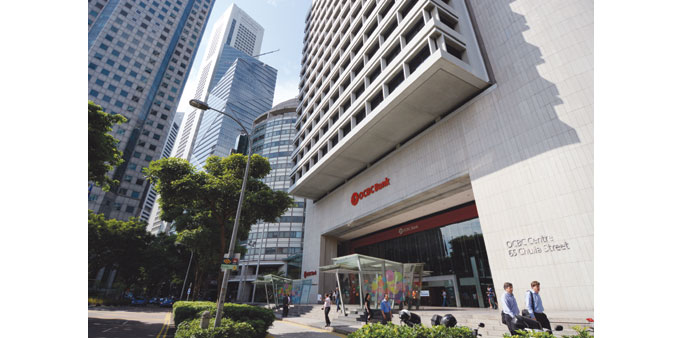
Pedestrians walk past the headquarters of Oversea-Chinese Banking Corp in Singapore. OCBC is closing the gap on top-ranked Singapore dollar bond arranger DBS Group Holdings, trailing by the narrowest margin on record last quarter.
Bloomberg
Singapore
Oversea-Chinese Banking Corp (OCBC) is closing the gap on top-ranked Singapore dollar bond arranger DBS Group Holdings, trailing by the narrowest margin on record last quarter.
OCBC helped issue S$1.56bn ($1.2bn) of offerings at home in the three months to March 31, boosting its market share to 32.4%, more than triple a year earlier, according to data compiled by Bloomberg. DBS worked on $1.62bn of deals for a 33.6% market share. OCBC was the sole manager on two issues for Singapore Telecommunications this year while DBS was on all three of its previous local- currency deals.
Singapore’s two largest lenders are vying for a smaller pool of profits, which has pushed them to expand overseas and into investment banking. New rules that require banks to reduce risky holdings, coupled with deposit rates less than 0.5% in the island nation, have prompted companies to sell more bonds in the local currency in the past five years than in the previous decade.
“Domestic growth opportunities are limited for the Singapore banks because the market is already mature,” Elaine Koh, a director in Fitch Ratings’ financial institutions team in Singapore, said. “It’s a competitive environment with tight lending margins.”
OCBC helped arrange 19 bond offerings last quarter, Bloomberg-compiled data show. United Overseas Bank ranked third with an 8% market share, followed by HSBC Holdings Plc at 7.3% and Australia & New Zealand Banking Group Ltd at 6.2%. Issues OCBC worked on included City Developments’ S$125mn of 3% 2020 notes and SingTel’s two sales totalling S$300mn.
City Developments’ bonds, sold at 100% of par, are trading at 100.25%, according to prices compiled by Bloomberg.
“An early Swedish mentor of mine often told me you’re only as good as your last deal, and this was something I brought with me to OCBC,” Pee Beng Kiong, the bank’s bond syndicate head, said by e-mail. “The team here spends some time to celebrate wins to foster greater camaraderie but we always make sure we’re looking for the next opportunity.”
For full-year periods, DBS has led the Singapore dollar bond league tables every year since 2004 except 2008, when OCBC ranked No 1, Bloomberg-compiled data show. It’s been a “slower start to the year for the Singapore dollar bond market because of the volatility going into 2015,” said Clifford Lee, head of debt capital markets at DBS. “New deals have been smaller and less frequent, but we can see the momentum improving.”
Deal volumes totalled S$4.83bn versus S$3.6bn in the last quarter of 2014, Bloomberg-compiled data show. Volumes last year were S$24.34bn and S$19.82bn in 2013.
DBS expects private banks to remain an active part of the investor base in Singapore and reckons new deals will come from a diverse range of companies, according to Lee. “We have to toggle between high yield and high grade issues to fit investors’ differing preferences as the market continues to stabilise,” he said by phone on March 30.
Lenders in Singapore also have to earn more fees such as those paid in bond transactions to increase profits because deposit growth has slowed, Fitch’s Koh said.
To increase earnings outside of its traditional business, DBS completed a string of acquisitions from 1999 to 2004 through which it added insurance and brokerage businesses as well as subsidiaries in Hong Kong and the Philippines.
OCBC has had a buying spree on its own that picked up with the acquisition of insurer Great Eastern Holdings in 2004 and culminated last year with the purchase of Wing Hang Bank for $5bn, the largest takeover of a Hong Kong financial institution since DBS offered $5.4bn for Dao Heng Bank in 2001.
“Another challenge the banks face is the slowing deposit growth in Singapore,” Koh said. “With the low deposit rates here, many would prefer to invest their cash rather than hold deposits with the bank. So even if the banks were to grow lending very quickly, how would they fund it? The focus has to shift from volume growth alone to more fee income.”
DBS in February reported investment banking fees increased 27% in 2014 to S$243mn as a result of more debt capital markets activity.
OCBC reported an operating profit from investment banking of S$1.98bn for 2014, up 10% on 2013.
“We’re a local bank, Singapore is our home market,” Tan Kee Phong, OCBC’s head of capital markets, said. “We have to know it well and do well here.”