


Agencies/Nairobi
Hundreds of Kenyans took to the streets yesterday demanding greater security following last week’s massacre by Somalia’s Shebaab Islamists, on the final day of mourning for the 148 people killed by the militants.
The demonstrators waved placards and chanted slogans as they marched on the streets of the Kenyan capital and the northeastern town of Garissa, where the massacre was carried out.
“We are mourning the loss of our fellow comrades, we have lost the vibrant blood that would have built tomorrow’s Kenya,” said Maureen Mucheri, 21, an engineering student at Nairobi University.
Later, hundreds gathered in a far quieter and deeply emotional demonstration in the capital, carrying flowers and lighting candles in front of scattered white crosses to remember those lost, at the end of the third and final day of national mourning.
The names of the victims were slowly read out amid the flickering candle light, with the solemn crowd quietly repeating their names.
Security forces meanwhile continued their hunt for those behind the university killings.
Earlier, in Garissa, several hundred people gathered at a rally where both Muslim and Christian leaders called for unity, with local Muslim leader Abdullahi Salat condemning the “violent and evil attack”.
In Nairobi, some 200 students slapped vehicles with their hands as they marched through the streets, chanting “you are not safe, you are not safe!”
Kenyan fighter jets pounded camps belonging to the Al Qaeda-linked insurgents in southern Somalia on Monday, but anger has been growing over allegations that critical intelligence warnings were missed.
Special forces units took seven hours to reach the university in Garissa last Thursday, some 365km from the capital, after Shebaab gunmen stormed dormitory buildings.
The extremists lined up non-Muslim students for execution in what President Uhuru Kenyatta described as a “barbaric medieval slaughter”.
Students in the demonstration carried placards with the slogan “147 is not just a number”, referring to the death toll in the massacre - although that has since risen to 148.
The massacre, Kenya’s deadliest attack since the 1998 bombing of the US embassy in Nairobi, claimed the lives of 142 students, three police officers and three soldiers.
“We shall not forget,” the Standard newspaper front-page read, as news media printed the faces of those killed in the attack, even as scores of relatives continue an agonising wait for the remains of their loved ones at the main mortuary in Nairobi.
Boniface Mwangi who organised the vigil in Nairobi’s Uhuru Park - or “Freedom” in Swahili - has been deeply critical of the country’s security failings.
“Entrenched corruption in the security system allows Shebaab to move freely in and out of Kenya and carry out such attacks with ease,” said Mwangi, a civil society activist.
The army said Monday’s airstrikes destroyed two Islamist bases, and followed a promise by Kenyatta that he would retaliate “in the severest way possible” against the Shebaab militants for their attack last Thursday.
Kenyan warplanes have made repeated strikes in southern Somalia since sending troops into their war-torn neighbour in 2011 to attack Shebaab bases, with Nairobi later joining the African Union force fighting the Islamists.
The Shebaab group has carried out a string of revenge attacks in neighbouring countries, notably Kenya and Uganda, in response to their participation in the AU force.
On Saturday, Shebaab warned of a “long, gruesome war” unless Kenya withdraws its troops from Somalia.
Shebaab fighters also carried out the Westgate shopping mall attack in Nairobi in September 2013, a four-day siege which left at least 67 people dead.
A Nairobi court yesterday ordered five Kenyans and a Tanzanian to be detained for 30 days while police investigate possible connections to the attack.
A $215,000 bounty has also been offered for alleged Shebaab commander Mohamed Mohamud, a former Kenyan teacher said to be the mastermind behind the attack and believed to now be in Somalia.
Authorities have named one of the four gunmen killed as a fellow Kenyan - a once promising university law graduate called Abdirahim Abdullahi, an ethnic Somali - highlighting the Shebaab’s ability to recruit within the country.
Although Kenyatta has vowed to retaliate for the massacre, there have also been calls for national unity.
In an address to the nation on Saturday, Kenyatta said people’s “justified anger” should not lead to “the victimisation of anyone” - a clear reference to Kenya’s large Muslim and Somali minorities in a country where 80% of the population is Christian.
Separately, Kenya is planning to speed up the repatriation of Somalis from the Dadaab refugee camp, the government said yesterday.
The Dadaab camp, which like the university lies in Garissa district, near the border with Somalia, is the world’s largest refugee camp, with more than half a million people.
The camp has been identified by Kenyan authorities as a recruiting ground for Shebaab.
“We have problems with (the refugees), that is a factor,” interior ministry spokesman Mwenda Njoka told DPA. “We will reduce the number so we can manage them more effectively.”
The Somali refugees would not be sent into areas controlled by Shebaab, Njoka explained. They would be relocated to areas in control of Somalia’s government.
“We don’t want people who are innocent to suffer because of Shebaab,” the spokesman said.
The closure of the camp was, however, not an option, said Njoka.
The decision comes a day after representatives from the north-eastern districts of Garissa, Wajir and Mandera, demanded the closure of the camp.
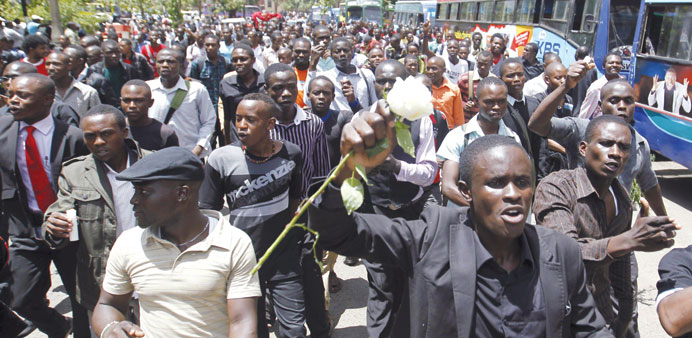
Kenyan university students participate in a demonstration at the Garissa University College campus, demanding better security.